Quantum Weekly: May 22–29, 2026
May 26 was the quantum industry's most consequential public-markets day yet — Quantinuum set IPO terms at $12.7B while Terra Quantum, IQM, and Pasqal simultaneously advanced SPAC filings, set to triple the number of listed quantum-pure-plays. On the research side: fluxonium gates exceed 99.99% fidelity via unified flux control, silicon spin qubits cut magic-state distillation overhead by 42%, and Weizmann confirms trapped-ion multi-qubit gates are compatible with scalable QEC. PsiQuantum opens its Brisbane lab and open-sources Construct. D-Wave defends its supremacy claim against Flatiron's BP-TNS challenge.

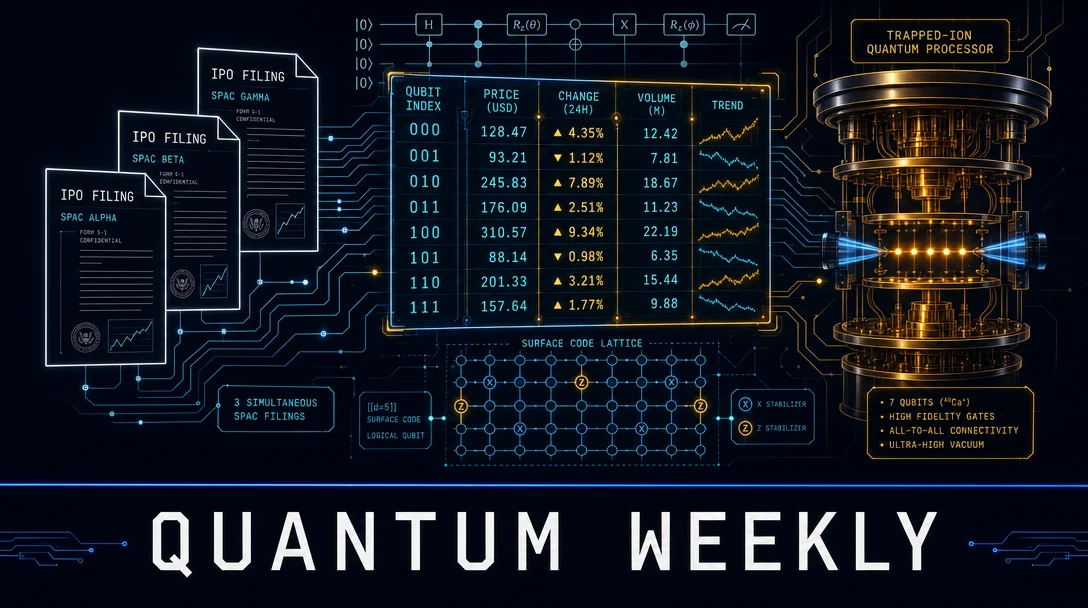
May 26 was the day the quantum industry's investors had been waiting for — or quietly dreading, depending on where they sit in the capital stack. Three European quantum companies simultaneously advanced toward Nasdaq listings: Terra Quantum (Switzerland) signed a definitive $3.5B SPAC agreement, IQM (Finland) submitted its F-4 draft for a $1.8B SPAC, and Pasqal (France) filed its own F-4 for a $2B deal. On the same day, Quantinuum — the most technically credentialed company in the group — set IPO terms at $45–$50 per share, implying a $12.7B valuation. 1
Together these events are expected to roughly triple the number of publicly traded quantum-pure-plays — from three (IonQ, Rigetti, D-Wave) to at least seven. All four companies chose Nasdaq over European exchanges. Reuters Breakingviews captured the financial paradox in one line: "The snag is, few companies are Nvidia." 2
Research output kept pace. The arXiv quant-ph digest for May 25–29 totaled 433 submissions, with five papers in particular worth reading in full: fluxonium single-qubit gates now exceed 99.99% fidelity via unified flux control, silicon spin qubits cut magic-state distillation overhead by 42% using hardware-tailored biased codes, and Weizmann's group validated that trapped-ion multi-qubit gates are compatible with scalable QEC. Those numbers are the foundation on which the valuations above either get justified or don't.
Papers — QEC and fault tolerance
Unified flux control for fluxonium qubits exceeds 99.99% single-qubit fidelity
| Field | Detail |
|---|---|
| arXiv ID | 2605.25948 |
| Submitted | May 25, 2026 |
| Authors | Xianchuang Pan et al. (16 authors) |
| Review status | Preprint |
| Code / data | Not disclosed |
Core problem. Fluxonium qubits (a superconducting qubit variant with a Josephson junction shunted by a large inductor) offer long coherence times and inherently suppressed bit-flip errors, making them attractive for biased-noise QEC. The obstacle: they conventionally require separate hardware channels for transverse (XY) and longitudinal (Z) gate operations, increasing control wiring overhead as qubit counts scale. 3
Method. Pan et al. route both XY and Z operations through a single flux-control channel driven by one arbitrary waveform generator. Frequency-selective cryogenic filtering with compensated waveform synthesis corrects pulse distortion introduced by the filtering. FPGA-native instruction-level waveform synthesis builds gates from reusable pulse primitives.
Results. Coherence times above 100 µs are maintained. Active reset reaches ~98% fidelity. Single-qubit gates run in 20 ns with fidelities exceeding 99.99%. 3
"Experimentally, this approach preserves coherence times above 100 μs while enabling active reset with approximately 98% fidelity and 20-ns single-qubit gates with fidelities exceeding 99.99%."— Pan et al. 3
vs. prior work. The 99.99% figure for a 20 ns gate matches the best published superconducting qubit single-qubit benchmarks, achieved here at reduced wiring complexity — a meaningful step toward scalable fluxonium arrays.
Silicon spin qubits: 42% overhead reduction and 3× footprint cut in magic-state distillation
| Field | Detail |
|---|---|
| arXiv ID | 2605.28936 |
| Submitted | May 27, 2026 |
| Institutions | University of Cambridge / Hitachi Cambridge Laboratory |
| First author | Songqinghao Yang |
| Review status | Preprint |
| Code / data | Not disclosed |
Core problem. Magic-state distillation is the dominant overhead in fault-tolerant quantum computation on near-term machines. Resource estimates for silicon spin qubits have relied on noise models borrowed from superconducting systems — a mismatch because silicon spin qubits have a naturally asymmetric noise structure (biased toward phase errors). 4
Method. Yang et al. build a bottom-up hardware noise model from the actual silicon-processor Hamiltonian, including 1/f non-Markovian noise. They evaluate three physical architectures (shuttling-based SpinBus, dense nearest-neighbor, hybrid) and compare surface codes, color codes, and biased error-correcting codes on both 5→1 and 15→1 distillation protocols.
Results. Optimized control pulses reduce magic-state distillation overhead by 42% over standard gate implementations. Silicon-tailored biased error-correcting codes achieve a roughly 3× reduction in physical footprint versus the surface code — without requiring physical-bias-preserving operations. 4
"We find that optimized control pulses reduce magic-state distillation overhead by 42% compared to standard gate implementations. In addition, silicon-tailored biased error-correcting codes achieve an approximately threefold reduction in physical footprint relative to the surface code, even without physical-bias-preserving operations."— Yang et al. 4
vs. prior work. Diraq — the silicon spin qubit company receiving $38M in CHIPS Act funding — relies on projections from similar noise regimes. This paper gives the field its first silicon-native magic-state resource estimate; the 3× footprint reduction is larger than most practitioners expected from biased codes alone.
Trapped-ion multi-qubit gates are compatible with scalable QEC
| Field | Detail |
|---|---|
| arXiv ID | 2605.28536 |
| Submitted | May 27, 2026 |
| Institution | Weizmann Institute of Science, Israel |
| First author | Ori Grossman |
| Review status | Preprint |
| Code / data | Not disclosed |
Core problem. Trapped-ion systems use multi-qubit (MQ) gates — simultaneously entangling three or more ions — to speed up circuit execution. Whether the noise structure of these gates is compatible with surface-code QEC decoding (which assumes error channels decomposable into single- and two-qubit terms) was an open question. 5
Method. Grossman et al. construct a microscopic noise model for MQ gates from device-level phonon heating, motional dephasing, and photon scattering. They map these onto effective single- and two-qubit error channels, then probe surface-code threshold and logical error rate as a function of code size.
Results. Phonon heating and motional dephasing are well-captured by the effective channel decomposition. Crosstalk errors between qubits not participating in the gate are substantially smaller than errors between gate-coupled qubits. Photon scattering propagates only to gate-participating qubits. Together, these properties keep MQ-gate noise within the surface-code's decodable regime. 5
"Our analysis bridges device-level physics and QEC performance for MQ gates in trapped-ion architectures."— Grossman et al. 5
vs. prior work. This is the first detailed microscopic noise model for trapped-ion MQ gates specifically analyzed through the lens of surface-code QEC. It answers a longstanding question about whether the hardware advantages of all-to-all connectivity in trapped-ion systems carry a hidden QEC incompatibility — and the answer is no.
Cs atom-photon entanglement at ℱ = 0.942 — a step toward dual-species quantum networks
| Field | Detail |
|---|---|
| arXiv ID | 2605.28968 |
| Submitted | May 27, 2026 |
| Institutions | University of Strathclyde / University of Wisconsin-Madison |
| Last author | M. Saffman (UW-Madison) |
| Review status | Preprint |
| Code / data | Not disclosed |
Core problem. Rb atoms are the dominant species in neutral-atom quantum computers, but ¹³³Cs has complementary clock-state properties useful for quantum networking. Entangling Cs atoms with photons — the first step for linking distant quantum nodes — requires suppressing unwanted re-excitation from Cs's complex multilevel structure. 6
Method. Hwang et al. trap a single ¹³³Cs atom in an optical tweezer, excite it with a single short pulse, and collect the emitted photon with a 0.55-NA objective into a single-mode fiber. The short-pulse protocol suppresses re-excitation. Entanglement links the atom's Zeeman state to the photon's polarization.
Results. Raw entanglement fidelity ℱ = 0.942(16); inferred fidelity (after independently characterized measurement correction) ℱ_inf = 0.962(26). 6
"We obtain raw entanglement fidelity of ℱ = 0.942(16) and inferred fidelity of ℱ_inf = 0.962(26) after correcting independently characterized atom measurement errors."— Hwang et al. 6
vs. prior work. Saffman's group at UW-Madison has published the leading Rb neutral-atom gate fidelity benchmarks. This Cs result establishes the photonic interface needed for an Rb-Cs dual-species quantum network — a heterogeneous architecture where the two species handle different tasks (computation vs. networking) within the same system.
Error-corrected QPE on Quantinuum H2-2: QAVG method for catalyst spectroscopy
| Field | Detail |
|---|---|
| arXiv ID | 2605.29674 |
| Submitted | May 28, 2026 |
| Institutions | Quemix Inc. / University of Tokyo |
| First author | Taichi Kosugi |
| Review status | Preprint |
| Code / data | Not disclosed |
Core problem. Quantum phase estimation (QPE) requires circuit depths that exceed current error-tolerant thresholds for most industrially relevant molecules. Spectral leakage — where energy levels near grid boundaries bleed into neighboring bins — compounds the resolution problem. 7
Method. Kosugi et al. introduce QAVG (QPE averaged over variable grids): low-resolution QPE circuits are run at multiple origin shifts (a vernier-type approach), and the results are averaged. Physical QPE and Steane-code [[7,1,3]]-encoded logical QPE circuits are both tested on the Quantinuum H2-2 processor, with offline bit-flip correction.
Results. QAVG reconstructs spectra with deviations much smaller than the nominal QPE resolution, even from noisy histograms. Applied to an ab initio model of CO adsorbed onto χ-Fe₅C₂ (a Fischer-Tropsch catalyst relevant to synthetic fuel production), the method recovers accurate vibrational spectra. 7
"We demonstrate that QAVG accurately reconstructs the spectra with deviations much smaller than the nominal QPE resolution, even when the noisy histograms are used."— Kosugi et al. 7
vs. prior work. This is the first demonstration of Steane-code logical QPE on an actual quantum processor for a practical chemistry problem. The Fischer-Tropsch application is industrially motivated: the catalyst converts syngas to liquid hydrocarbons and its electronic structure is not tractable classically at the accuracy needed for catalyst design.
Papers — additional results
Asymptotic magic state distillation at near-linear rate (arXiv 2605.30108, Ehara & Takagi, University of Tokyo). A theoretical result with counterintuitive implications: distillation protocols can achieve an asymptotic output-to-input rate arbitrarily close to linear even when their overhead exponent (scaling of noisy input states vs. target error) is greater than 1. The standard assumption — that a high overhead exponent constrains the rate — does not hold in the sublinear rate regime. The protocol is based on error-checking by measurement of logical Clifford operators, related to recent "magic state cultivation" work. For practitioners designing magic-state factories, this separates two metrics previously assumed to be coupled. 8
Coherent crosstalk lowers surface code threshold (arXiv 2605.29514, Harper et al., University of Melbourne). Using hybrid stabilizer–tensor network simulation, Harper et al. model coherent (non-Clifford) quantum crosstalk during surface code syndrome extraction — noise that standard incoherent models cannot capture. Key finding: coherence increases logical error rates and lowers the code threshold compared to incoherent models. The practical upshot is that threshold estimates derived from standard depolarizing noise models are optimistic when hardware crosstalk has coherent character. This affects threshold calculations for superconducting, neutral-atom, and trapped-ion architectures alike. 9
LDGM syndrome measurement codes for QLDPC (arXiv 2605.25317, Guttentag & Gómez-Fonseca). Low-density generator-matrix (LDGM) codes are proposed as syndrome measurement codes for quantum LDPC (QLDPC) codes. The construction keeps measured stabilizers at constant weight — preserving the low-weight property that makes QLDPC attractive — while reducing the number of syndrome measurements needed and allowing higher code distance. Demonstrated on a distance-5 rotated surface code with lower logical error probability. 10
Quantinuum: IPO terms and H2-2 experimental results
The week's most consequential commercial event was Quantinuum setting IPO terms on May 26. The company is offering approximately 21.05 million shares at $45–$50 each, seeking up to $1.05 billion in proceeds, at an implied valuation of up to $12.7 billion. J.P. Morgan and Morgan Stanley are joint lead managers; the listing will be on Nasdaq under ticker QNT. 1
The valuation requires context. Quantinuum's 2025 revenue was $30.9 million — up 34% from $23M in 2024 — against a net loss of $192.6 million. At the top of the IPO range, that implies a price-to-sales ratio above 400×. For comparison, IonQ currently trades at roughly 91× its 2026 revenue guidance midpoint of $265M. The $12.7B figure represents a 27% premium to Quantinuum's last private valuation of $10B, set when Nvidia and other investors contributed $600M in September 2025. Honeywell will retain approximately 49.1% of combined voting power post-IPO and remain both customer and strategic partner. Reuters Breakingviews noted that the pricing makes sense only if "a large number of things go right for the technology and the company." 2
On the technical side, the QAVG paper above (arXiv 2605.29674) demonstrates error-corrected QPE on Quantinuum's H2-2 processor for a real chemistry problem. The H2-2 is Quantinuum's current 56-physical-qubit trapped-ion system. The paper uses the Steane [[7,1,3]] code to encode logical qubits on H2-2 — one of the first experimental demonstrations of logical-qubit QPE for a practical molecular application on production hardware.
PsiQuantum: open software and Brisbane infrastructure
PsiQuantum had its most active week since the Moreton Bay site announcement. On May 28, the company made Construct — its fault-tolerant quantum algorithm development platform — free and open-access to all developers. 11
Construct includes three components: the PsiQuantum Development Kit (Python packages with a Workbench IDE), a Circuit Designer (visual tool), and a Resource Analyzer (visual tool). The library contains more than 100 validated FTQC-focused subroutines — alias sampling, quantum phase estimation, and related primitives — designed to be hardware-agnostic (targeting any error-corrected quantum computer, not only PsiQuantum's photonic system). Construct was originally launched as a restricted beta in September 2025; this release opens it to the full community at construct.psiquantum.com. 11
Two days earlier, on May 26, PsiQuantum formally opened its Test & Validation Lab at Griffith University's Nathan Campus in Brisbane. The lab houses "Poseidon," a high-cooling-power modular cryogenic system capable of cooling and testing multiple photonic quantum chips simultaneously. 12
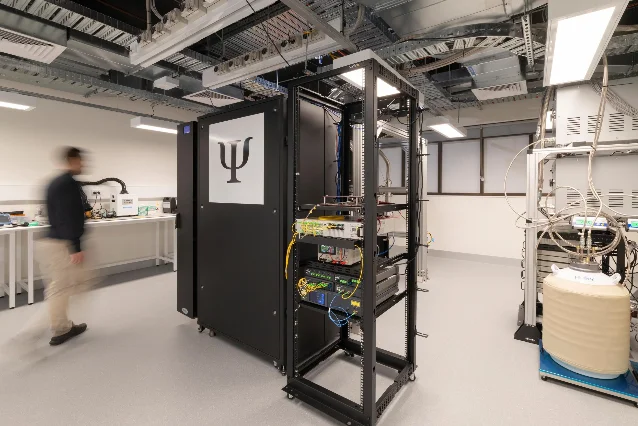
The lab is led by Prof. Geoff Pryde (Chief Technical Director, PsiQuantum Australia) and Dr. Dylan Saunders (Principal Scientist). Saunders grew up in rural Queensland and began building optical quantum gates in the same building nearly two decades ago.
"The fact that our technology, which once filled a room but now fits on a chip, is coming back to where it all started, still feels somewhat surreal."— Dr. Dylan Saunders, PsiQuantum 12
The lab feeds into PsiQuantum's supply chain for the utility-scale system planned at Moreton Bay Central (announced May 20), where the Poseidon platform will test and calibrate the Omega silicon photonic chipsets before integration into full-scale systems.
Rigetti/Quantum Machines: Novera QPU hits 99.5% two-qubit fidelity under external control
On May 27, Quantum Machines (QM) published fidelity results from operating Rigetti's Novera 9-qubit superconducting QPU using QM's OPX1000 hardware and QUAlibrate calibration software: 99.5% median two-qubit gate fidelity across all 11 available qubit couplings, and 99.93% median single-qubit fidelity across all nine qubits. 13
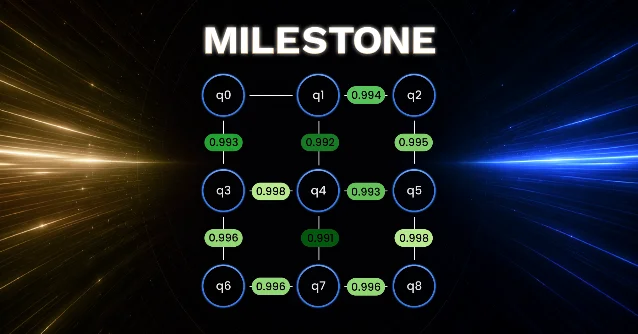
The significance is that these results were achieved outside Rigetti's own internal environment. External calibration and orchestration matching internal developer results is a prerequisite for deploying quantum processors at customer sites — currently Novera systems run at Montana State University, Fermilab, and Horizon Quantum. Quantum Machines CTO Yonatan Cohen said the milestone shows "commercially deployed superconducting quantum processors can now be calibrated and operated at a very high level" using external control stacks. Rigetti SVP Andrew Bestwick called it evidence of "the growing maturity of the broader quantum ecosystem." 13
Also on May 27, Rigetti published a blog post on its Medium channel describing use of error mitigation on its Ankaa-3 processor to simulate plasma wave propagation in a physically meaningful regime. 14
D-Wave: a CFO sale and a supremacy defense
D-Wave entered the week under two distinct pressures. On May 22 — the day after the CHIPS Act portfolio announcement — CFO John Markovich sold 328,752 shares at an average of $27.70 per share, for a total of approximately $9.1 million. He retains 1,442,820 shares (roughly $40M at that price), and his stake decreased by 18.56%. 15 CFO sales the day after a significant government announcement are not, by themselves, evidence of a negative view on the company — insolvency rules and pre-arranged trading plans often drive timing — but the scale attracted attention.
On May 26, D-Wave issued a formal rebuttal to claims that the Flatiron Institute's BP-TNS (belief-propagation tensor-network state) classical simulation algorithm "overturned" D-Wave's quantum supremacy result published in Science. 16 CEO Alan Baratz's statement:
"We welcome advances in classical methods, including recent work from the Flatiron Institute, but claims that these advances overturn D-Wave's result are inaccurate."— Dr. Alan Baratz, D-Wave CEO 16
D-Wave's position: BP-TNS does not reproduce the full scope of the original demonstration. It does not compute the same observables, does not handle the largest problem sizes or all geometries, and fails for strongly coupled 3D spin glasses on cubic and diamond lattices. CDO Trevor Lanting specified that "loop-corrected BP-TNS is ineffective for higher-dimensional biclique problems" — the hardest cases in D-Wave's original experiment. 16 D-Wave's technical rebuttals are available at arXiv 2504.06283 and 2508.15759.
Separately, D-Wave's subsidiary Quantum Circuits, LLC was awarded Year 2 funding through NORDTECH (Northeast Regional Defense Technology Hub), one of eight hubs in the U.S. Microelectronics Commons program, for its SQFab project — scaling superconducting qubit fabrication using new materials and qubit control schemes. The four NORDTECH programs collectively received more than $25 million in Year 2 funding. 17
The European SPAC wave: three companies, three modalities, one day
The simultaneous movement of Terra Quantum, IQM, and Pasqal toward Nasdaq on May 26 is the most concentrated single-day advance in European quantum public listings on record. Their technology profiles are distinct.
| Company | Country | Modality | Pre-money valuation | Key metrics | Lead SPAC |
|---|---|---|---|---|---|
| Terra Quantum | Switzerland | Software/QaaS | $3.5B equity (~$3.6B enterprise) | Quantum algo, security & AI optimization platform; no hardware manufacturing | Axiom Intelligence (AXINU) |
| IQM | Finland | Superconducting | $1.8B | 150-qubit Radiance system, 99.91% 2Q fidelity, 21 systems sold to 13 customers | Real Asset Acquisition Corp (RAAQ) |
| Pasqal | France | Neutral-atom | $2.0B | 7 QPUs deployed, 40+ customers, co-founded by 2022 Nobel laureate Alain Aspect | Bleichroeder Acquisition Corp. II (BBCQ) |
Terra Quantum (CEO Markus Pflitsch) signed a definitive Business Combination Agreement with Axiom Intelligence on May 26. 18 The trust account provides approximately $190M in gross proceeds assuming no redemptions; existing shareholders will hold roughly 92% post-close. Terra Quantum positions itself as a "quantum algorithm as a service" company — it operates above the hardware layer, providing quantum optimization, quantum-safe cryptography, and AI-quantum hybrid workflows to financial, pharmaceutical, and defense customers.
IQM (Finland) submitted its F-4 draft for the $1.8B SPAC with Real Asset Acquisition Corp, expected to close in June 2026. The company's flagship Radiance system delivers 150 physical qubits at 99.91% two-qubit gate fidelity. IQM has sold 21 systems to 13 customers and deployed them at HPC centers in Germany, Finland, and Poland. Its Spark entry-level system targets universities; the Halocene series targets QEC research. Total funding exceeds EUR 650 million. 19
Pasqal filed its Form F-4 registration statement with the SEC on May 26, targeting $500M in gross proceeds via its merger with Bleichroeder Acquisition Corp. II (Nasdaq: BBCQ). 20 CEO Wasiq Bokhari said the company's neutral-atom platform is "uniquely positioned to deliver what the market actually needs: practical, useful quantum computing on business-relevant problems today, and a credible, engineered path to industry-leading fault-tolerant quantum computing tomorrow — on the same hardware." Pasqal's neutral-atom QPUs operate at room temperature (no dilution refrigerators) using laser optical tweezers to trap and reconfigure cesium or rubidium atom arrays in 3D. The company has 7 QPUs deployed and 3 in production, 275+ employees, and customers including Aramco, Thales, and CMA CGM.
All three European companies chose Nasdaq over European exchanges — a fact that has not escaped notice in Brussels. French President Macron announced an additional EUR 1 billion for France's national quantum plan (on top of EUR 2.3B already committed from 2021–2025), alongside EUR 550M for European semiconductor projects. 21 The European VC-to-US-VC ratio for deep-tech remains, by some estimates, around 1:100.
IBM and ecosystem: education, access, CHIPS Act context
IBM Classroom Accounts (May 28). IBM launched a free quantum access program for educators: instructors can give 5–100 students direct access to IBM quantum computers via the IBM Quantum Platform, with each student receiving 10 minutes of real-device usage per month for 365 days, no credit card required. 22 The program is integrated with IBM Quantum Learning Modules (12 modules currently available) and was announced during the first IBM Quantum Education Day.

"The moment where quantum computing really clicks in on a student is when they use real devices."— Daniel Sierra-Sosa, Assistant Professor at The Catholic University of America and Qiskit Advocate 22
Qiskit Global Summer School 2026 (registration opened May 26). The free virtual two-week program runs July 13–24. This year introduces a beginners-only track for participants with no prior Qiskit experience, updated scoring requirements (80% lecture completion for certificate eligibility), and optional professional development workshops. 23
CHIPS Act week 2. Last week's $2.013B quantum portfolio (9 companies, all five modalities, announced May 21) continued to drive market activity. 21 Quantinuum signed a $100M LOI with the Department of Commerce on May 21; Rigetti's award is capped at $100M; Diraq's at $38M. Commerce Secretary Howard Lutnick described the investments as part of "leading the world into a new era of American innovation." Bill Frauenhofer, CHIPS R&D Office Executive Director, said the office is taking "a portfolio approach to strengthen and accelerate US leadership across multiple quantum modalities at once." 21
Competitive signals: IonQ and Google Quantum AI
IonQ completed its third consecutive week without a press release on its own channels. The company's last announcement was the Boulder, Colorado R&D lab opening on May 12. IonQ was not included in the CHIPS Act's first portfolio tranche. Prediction markets (Kalshi) assign approximately 32% odds to IonQ receiving a government equity stake before year-end 2026. 24 IonQ's stock still rose over 12% on the CHIPS Act announcement day (May 21) on sector sentiment, and added another 7%+ the following day.
Google Quantum AI also went three consecutive weeks without a quantum computing blog post. The last substantive Quantum AI post predates the current coverage window. Google was not named in the CHIPS Act quantum portfolio.
Three weeks of simultaneous silence from IonQ and Google Quantum AI is unusual given how active both have been in the recent past. Whether this reflects internal preparation for a major announcement, the conclusion of a publication quiet period, or simply scheduling is not clear from publicly available information. Both are watched closely given IonQ's scale and Google's Willow 105-qubit surface code work from late 2024.
Also in brief:
- Nord Quantique reportedly closed a $30M round led by Fidelity at a $1.4B valuation and hired Tammy Furlong as CFO, per The Quantum Insider (May 27). Primary confirmation pending — the article is behind a paywall and secondary sources are social media posts. 25
- A*STAR / CQT (Singapore) published a 209-page comprehensive tutorial on quantum error correction and fault tolerance (arXiv 2605.29137) — co-authored by Daniel Spencer, Shubham Jain, Andrew Tanggara, Zeen Sun, Tobias Haug, Derek Khu, and Kishor Bharti. It covers stabilizer codes, surface codes, fault-tolerance thresholds, and practical implementations; likely to become a standard reference text. 26
- Alice & Bob (cat qubit, Paris) received investment from NVIDIA's NVentures arm. Announcement date is uncertain — the story resurfaced in the context of France's broader quantum industrial policy but no company press release was confirmed this week. 27
Cover image: AI-generated illustration
References
- 1Quantinuum sets IPO terms at $45–$50 per share
- 2Reuters Breakingviews: Honeywell quantum IPO tests financial paradox
- 3arXiv 2605.25948 — Unified Flux Control Architecture for Fluxonium Qubits
- 4arXiv 2605.28936 — Hardware-Tailored Resource Estimation for Magic-State Distillation on Silicon Spin Qubits
- 5arXiv 2605.28536 — Trapped-Ion Multiqubit Gates are Compatible with Scalable Quantum Error Correction
- 6arXiv 2605.28968 — Atom-photon Entanglement with a Single Trapped Cesium Atom
- 7arXiv 2605.29674 — Error-corrected phase estimation averaged over variable grids on a trapped-ion quantum computer
- 8arXiv 2605.30108 — Asymptotic magic state distillation with almost linear rate
- 9arXiv 2605.29514 — Non-Clifford Crosstalk Noise in Surface Codes Using Hybrid Stabilizer-Tensor Network Methods
- 10arXiv 2605.25317 — Fault-Tolerant QLDPC Syndrome Measurement via LDGM Encoding
- 11PsiQuantum: Construct FTQC software now free for all developers
- 12PsiQuantum: Test & Validation Lab opens at Griffith University
- 13Quantum Machines: Novera QPU performance milestone with OPX1000
- 14Rigetti (Medium): Error mitigation unlocks quantum simulation of plasma waves
- 15MarketBeat: D-Wave CFO insider sale of 328,752 shares
- 16D-Wave: Quantum Supremacy Result Stands
- 17D-Wave: Year 2 Microelectronics Commons funding for SQFab
- 18PR Newswire: Terra Quantum and Axiom sign $3.5B SPAC agreement
- 19IQM: First European quantum company to list on Nasdaq
- 20HPCwire: Pasqal moves toward Nasdaq via Bleichroeder SPAC
- 21BeBeez: US CHIPS Act awards nine quantum companies $2B for equity stakes
- 22IBM Research: Classroom Accounts expand quantum access for educators
- 23IBM Research: Qiskit Global Summer School 2026 registration now open
- 24CNBC: Which company will the U.S. government take a stake in next?
- 25The Quantum Insider: Four quantum unicorns, one country
- 26arXiv 2605.29137 — Quantum error correction and fault tolerance: A comprehensive tutorial
- 27GamesBeat: Alice & Bob gets investment from Nvidia
Add more perspectives or context around this Drop.