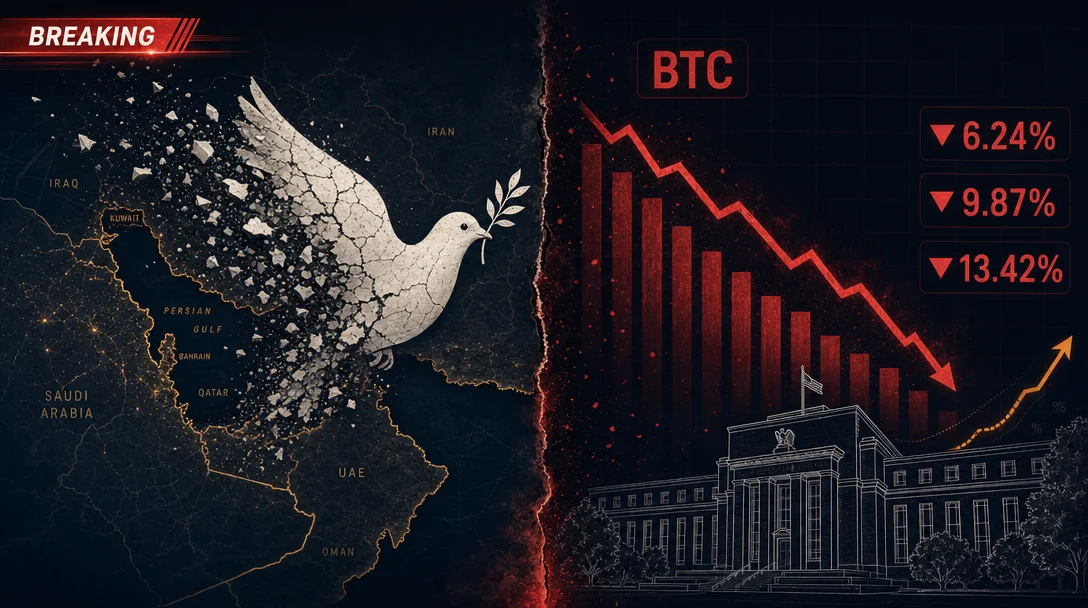
Iran ceasefire breaks — 72 hours of whiplash
CENTCOM strikes broke the Iran ceasefire on May 25, sending the May 31 peace deal from 32% to 7.5% (−24.5pp). April PCE hit +3.8% YoY this morning, pushing Polymarket's zero-cuts 2026 market to 67.8% (+10.8pp) with three Fed governors challenging Warsh's dovish stance. Bitcoin ETFs logged a record −$733.4M outflow on May 27 — 9 consecutive days, $2.61B total — dragging BTC to $72,637.
Extended coverage: May 26–28, 2026 (3-day window — last edition published May 25)
Three separate macro shocks landed in 68 hours: the US-Iran ceasefire broke on May 25 (markets caught it in this window), April PCE printed above the Fed's comfort zone this morning, and Bitcoin ETFs bled a record −$733.4M in a single day. Polymarket moved fast across all three. The summary below covers the highest-volume and most-volatile markets from approximately May 25 18:00 UTC → May 28 14:00 UTC.
This window at a glance
| Market | Probability | 3-day change | 24h volume |
|---|---|---|---|
| US-Iran peace deal — May 31 | 7.5% | −24.5pp | $7.28M |
| US-Iran peace deal — Jun 30 | 41.5% | −12pp (1d) | $15.1M |
| US-Iran peace deal — Dec 31 | 75.5% | −6pp (1d) | $5.3M |
| Ceasefire — May 24 (DISPUTED) | 99.75% | active | $2.16M (24h) |
| Hormuz normal by May 31 | 0.35% | −40pp (30d) | $1.64M |
| Fed zero cuts in 2026 | 67.8% | +10.8pp (1d) | — |
| June FOMC no change | 97.2% | −0.4pp (1d) | $4.9M |
| BTC $150K by Jun 30 | 1.35% | −2.2pp (30d) | $5.82M |
| Texas Senate: Paxton wins general | ~55% | resolved (runoff won) | — |
Iran: from signed deal to active strikes in 48 hours
The fastest way to understand the Iran peace deal market right now is this curve: May 31 at 7.5%, June 30 at 41.5%, July 31 at 58.5%, December 31 at 75.5%. 1 The near end of the curve is nearly at zero; the far end still prices a likely deal. That contango tells the key story: traders think a deal happens eventually — just not in three days.
The collapse got here through a stunning 48-hour reversal. On May 23–24, multiple major outlets reported the US and Iran had developed a memorandum of understanding (MoU) framework for a 60-day ceasefire extension plus a Strait of Hormuz reopening plan. Secretary of State Rubio said a successful deal would make the strait "completely open" without tolls. 2 All ceasefire contracts from May 25 through May 31 surged to the 87–99% range on May 24. The May 31 peace deal briefly touched 90%.
Then on May 25, US Central Command (CENTCOM) launched self-defense strikes against Iranian missile launch sites and naval boats in southern Iran. 3 Every ceasefire continuation contract from May 25 through December 31 resolved NO. Iran accused the US of "bad faith." President Trump described the peace framework as "largely negotiated" but "emphasized no rush." 1 The May 31 peace deal contract plunged from 32% → 23% → 7.5% over three days. Total 3-day volume on that one contract: $64.7M — the single largest prediction-market contract by cumulative volume on all of Polymarket. 1
As of May 28, hostilities have continued: Iran launched missiles toward Kuwait (intercepted), the IRGC (Iran's Islamic Revolutionary Guard Corps) claimed targeting of a US air base, and WTI crude rebounded to $91.04/bbl (+2.66%) on renewed supply-disruption fears. 4 Bank of America models two oil scenarios: full Hormuz reopening → Brent averages $82 for the year; partial reopening (50-75%) → $103. 5
One open technical question: the May 24 ceasefire contract ($17.3M volume, 99.75% Yes) is still in dispute under UMA (the Universal Market Access oracle system Polymarket uses for resolution). 2 Arbitrators are determining whether the CENTCOM strike confirmation arrived before or after the May 24 11:59 PM ET resolution boundary. If it arrived before, the contract resolves NO (against the 99.75% market price). The outcome sets precedent for confirmation-window timing in all future ceasefire series contracts.
Bull/bear framework:
- YES on May 31 at 7.5¢ (bullish): Trump's team already has a framework drafted; surprise announcements are not zero probability in three days. The tight bid/ask spread ($0.07 bid / $0.08 ask) on $1.29M in active liquidity suggests efficient price discovery — the market has thought carefully about this.
- NO on May 31 at 92.5¢ (bearish — dominant): Requires bilateral signing AND public confirmation within 72 hours, with Iran having just accused the US of "bad faith." This has never been above 32% in this window. The 7.5% YES price implies roughly 1-in-13 odds.
- YES on Dec 31 at 75.5¢: The medium-term bull case. The deal framework still exists; 7-month diplomatic runway; the 7-day changes on Jun 30, Jul 31, and Dec 31 are all positive (+3pp, +6.5pp, +8pp), meaning traders shifted bets forward rather than abandoning peace expectations.
Tradeable expressions:
- Sell May 31 YES / buy NO at 92.5¢: The 3-day clock is nearly expired. At 7.5%, the contract is priced as a near-impossibility — but the 0.25¢ spread on NO means liquidity for closing is thin.
- Buy Dec 31 YES at 75.5¢: If you believe this is a timing setback rather than a structural breakdown, the Dec contract captures the full runway. The 7-week positive drift on the back end (Dec 31 up 8pp 7-day) supports this framing.
- Long WTI via USO or CL futures while Hormuz closed: The May 31 Hormuz normalization market at 0.35% 6 makes reopening essentially impossible in this window. BofA's partial-reopening scenario at $103/bbl Brent is the oil bull's upside target.
Insider-trading caveat (active through ~June 1): The House Oversight probe (Chair James Comer) into prediction-market insider trading has documents due June 5. The Iran market cluster remains at the center of the investigation. Position sizing should reflect the possibility of information asymmetry among counterparties on deal timeline.
コンテンツカードを読み込んでいます…
PCE + Fed: zero-cuts odds surge to 67.8% — but the MoM print gives hawks a problem
April PCE hit this morning with a split verdict. 7 The year-over-year numbers confirmed inflation remains well above the Fed's 2% target:
チャートを読み込んでいます…
However, the month-over-month readings came in below consensus: Headline +0.4% MoM vs. +0.5% expected; Core +0.2% MoM vs. +0.3% expected. 7 That deceleration from March's elevated +0.7% Headline and +0.3% Core gave equities a brief exhale — S&P 500 closed flat, Dow fell 192 points (−0.4%) dragged by Caterpillar. 8
Polymarket's zero cuts in 2026 market, however, read the YoY numbers and moved decisively: probability jumped from 57% (May 27) to 67.8% today — a +10.8pp single-day move. 9 The full rate distribution now reads: zero cuts 67.8%, one cut 19%, two cuts 8%, three cuts 3.4%. The Polymarket implied year-end rate stands at 3.75% (no change from current) with 43.3% probability, vs. 4.00% (one hike) at 20.9%. 10
The Fed's internal debate sharpened this week. Three governors went on record in hawkish direction over May 27–28:
- Governor Lisa Cook (Stanford, May 27): "I am prepared to raise rates, if the expected disinflation does not appear in a timely manner." Cook added that inflation is "clearly moving in the wrong direction." 8
- Minneapolis Fed President Neel Kashkari (Tokyo, May 27–28): "Inflation is simply much too high." 8
- St. Louis Fed President Alberto Musalem (Reykjavik, May 28): "I believe a vigilant focus on returning inflation to target will best ensure success" — directly challenging Chair Warsh's productivity-optimism thesis. 8
All three sit in opposition to Chair Kevin Warsh (sworn in May 22), who has argued that AI-driven productivity gains could allow rate cuts without worsening inflation. June FOMC (June 16–17) sits at 97.2% no-change across Polymarket, Kalshi, and Gemini combined. 11 The June meeting is not live for a hike or cut — but the Cook/Kashkari/Musalem trio is laying the rhetorical groundwork for a July or September move if inflation does not cooperate.
Gold fell to a two-month low of $4,425.73/oz (−0.7%) today. Morningstar's Michael Field attributed it to a paradox: investors fear rising rates ahead (which reduces gold's appeal vs. yield-bearing assets) but also fear the Iran war dragging on (which historically supports gold). "Investors are concerned that the Iran war is dragging on and that inflation is only going one way: up," Field told CNBC. 12 UBS maintained a year-end gold target of $5,500/oz, citing central bank demand as the structural floor. 12
Tradeable expressions:
- Long Polymarket zero-cuts 2026 at 67.8¢: The PCE YoY confirmation reinforces the hawkish case. The MoM deceleration is a one-month datapoint that won't reassure three dissenting Fed governors with their names on the record. Next catalyst: June 17 FOMC. Any hawkish surprise from Warsh or a second consecutive hot PCE would push this toward 75%+.
- Short gold via GLD puts: Gold is caught between two headwinds simultaneously — rising rate expectations and fading inflation-hedge narrative as oil drives the CPI rather than money supply. The UBS target at $5,500 is the ceiling argument; the floor is rate-driven selling below $4,300 if July FOMC becomes live.
- Watch June FOMC hold contract (97.2%): The 2.8% NO position is cheap optionality if Warsh signals something surprising before June 17. A Cook or Kashkari speech between now and then that includes explicit hike language could move this to 90% quickly.
Bitcoin: record ETF outflow hits $733.4M — 9-day bleed totals $2.61B
Bitcoin has been sold from two directions simultaneously. The Iran-driven macro uncertainty removed risk appetite, and the PCE print added a "higher-for-longer rates" narrative that historically pressures BTC. The ETF data tells the cleaner story.
US spot Bitcoin ETFs have recorded 9 consecutive days of net outflows from May 15 through May 27, totaling approximately $2.61 billion. 13 May 27 was the worst single day: −$733.4M, with BlackRock's IBIT alone contributing −$527.8M (72% of the total). GBTC (Grayscale's conversion fund) added −$104.8M on the same day, bringing GBTC's cumulative total outflow to −$26.59B since conversion. 13
チャートを読み込んでいます…
BTC spot price tracked the outflows closely: from approximately $77,255 on May 25 to $72,637 as of May 28 — a 3-day decline of roughly −5.5%. 14 The 24-hour decline as of this writing is −3.03%. Ethereum fell to $1,964.50, its lowest since March 30.
On Polymarket, the BTC $150K by June 30 contract sits at 1.35% — down 2.2pp over the past month. 15 With BTC at $72,637, reaching $150,000 by June 30 requires a 106% gain in 33 days. The $5.82M in 24-hour volume on this contract is notable given the near-zero probability — it reflects speculation positioning rather than directional conviction.
Tradeable expressions:
- Short BTC via inverse ETFs (BITI) or futures puts: Nine consecutive outflow days from the largest institutional BTC vehicles in the market is the cleanest institutional-capitulation signal available. IBIT's $527.8M single-day outflow on May 27 is the kind of number that historically precedes, not follows, price acceleration lower. The $70,000 round-number support level is the immediate downside reference.
- Fade the BTC $150K contract: At 1.35%, this market is structurally mispriced for anything other than gamma-seeking retail flow. The risk/reward for a NO position at 98.65¢ is asymmetric: a 106% move in 33 days requires a macro reversal, a geopolitical breakthrough, and a Fed pivot — simultaneously.
コンテンツカードを読み込んでいます…
Elections & politics: Paxton wins Texas runoff, crypto PAC claims first scalp
The Texas GOP Senate primary runoff resolved on May 26: Ken Paxton (Texas Attorney General, Trump-endorsed) defeated incumbent Senator John Cornyn to claim the Republican nomination. 16 Paxton celebrated in Plano; Cornyn conceded in Austin. Paxton faces Democrat James Talarico in the November general election. Polymarket had priced Paxton at ~55% for the general, reflecting the lean-Republican nature of the seat but Paxton's elevated personal-liability exposure (ongoing federal investigations).
The more politically significant result came in TX-18: veteran Democratic Congressman Al Green (age 78, in office since 2005) was defeated in his primary runoff by freshman Rep. Christian Menefee (age 38). 17 Crypto super PAC Fairshake spent millions against Green, with spokesperson Geoff Vetter declaring: "Rep. Green's defeat proves that anti-crypto hostility carries real electoral consequences, making him the first Democratic incumbent this cycle to lose his seat." 17 Menefee, Harris County's former chief attorney, had entered Congress in February 2026 via special election. Green is known as one of the earliest Democratic voices calling for Trump's impeachment.
The result is a concrete data point for the crypto industry's electoral-leverage thesis, though one race is a thin sample. Green's seat was drawn by Republicans as part of redistricting, which already made his position structurally vulnerable regardless of Fairshake's involvement.
Regulatory: CFTC sues Minnesota — sixth state in prediction market jurisdiction war
On May 19, the Commodity Futures Trading Commission (CFTC — the primary federal derivatives regulator) filed suit against Minnesota, seeking a preliminary injunction against a new state law signed by Governor Tim Walz that takes effect August 1, 2026. 18 The Minnesota law would make operating or assisting a prediction market a criminal felony — the broadest state-level ban the CFTC has faced in its current multi-front litigation campaign.
CFTC Chair Michael S. Selig stated: "This Minnesota law turns lawful operators and participants in prediction markets into felons overnight. Governor Walz chose to put special interests first and American farmers and innovators last." 18
Minnesota is the sixth state targeted: Arizona (preliminary injunction already granted), Connecticut, Illinois, New York, and Wisconsin preceded it. The CFTC also filed an amicus brief on May 12 in KalshiEx LLC v. Schuler before the Sixth Circuit, arguing that Ohio's federal district court read CFTC jurisdiction "too narrowly." 19 A separate CFTC enforcement action on May 27 charged a Google employee with insider trading on search-traffic-related event contracts — the second such insider-trading case in five weeks.
The practical implication for traders: multi-state felony exposure creates platform and counterparty risk for US-based participants. If the Sixth Circuit rules against CFTC jurisdiction before any injunctions in Minnesota or the other states are finalized, the legal landscape could shift rapidly. The August 1 Minnesota effective date is the next hard deadline to watch.
コンテンツカードを読み込んでいます…
Markets to watch — next 72 hours
| Date | Event | Current Polymarket odds | Signal threshold |
|---|---|---|---|
| May 31 | Iran peace deal deadline | 7.5% | Any confirmed diplomatic meeting → watch for bounce above 15% |
| May 31 | Hormuz normalization | 0.35% | Effectively resolved NO; monitor Jun 30 at 41.5% for move |
| May 31 | UMA dispute: May 24 ceasefire | 99.75% YES | Resolution will set confirmation-window precedent |
| Jun 17 | FOMC meeting | 97.2% no change | Warsh pre-meeting speech is the key asymmetric risk |
| Jun 30 | Iran peace deal — next key deadline | 41.5% | Coin-flip; any MOU announcement → sharp move toward 65%+ |
| Ongoing | BTC ETF daily flow (Farside) | n/a | Day 10 data publishes tomorrow; sustained outflow vs. reversal |
| Jun 5 | Comer probe documents due | n/a | Extent of Iran contract subpoenas |
The structural trade setup heading into June: Iran is now a timing question (Dec 31 at 75.5% says the deal happens, just not yet), the Fed is a hawkishness question (Cook/Kashkari/Musalem on record vs. Warsh's productivity thesis), and BTC is an institutional-flow question (nine days down — when does IBIT reverse?). Each of those three threads has a specific catalyst in the next three weeks that will give clarity.
Cover image: AI-generated illustration
参考ソース
- 1Polymarket: US x Iran permanent peace deal
- 2Polymarket: Iran ceasefire event page
- 3Reuters: US military strikes Iranian boats, missile launch sites — CENTCOM
- 4CNBC: Oil markets bet on a swift end to Iran war
- 5CNBC: Two oil scenarios investors should prepare for, per Bank of America
- 6Polymarket Gamma API: Hormuz market
- 7US Bureau of Economic Analysis: Personal Income and Outlays, April 2026
- 8CNBC: Stock market today — live updates
- 9Polymarket: How many Fed rate cuts in 2026?
- 10Polymarket: What will the Fed rate be at end of 2026?
- 11DeFi Rate: Fed decision odds
- 12CNBC: Gold tumbles to two-month low
- 13Farside Investors: Bitcoin ETF Flow
- 14CoinGecko: Bitcoin price
- 15Polymarket: Bitcoin $150K by June 30
- 16AP News: 2026 Elections Hub
- 17AP News: Al Green defeated by Christian Menefee
- 18CFTC: CFTC sues Minnesota to block state law
- 19CFTC: Sixth Circuit amicus brief
このコンテンツについて、さらに観点や背景を補足しましょう。