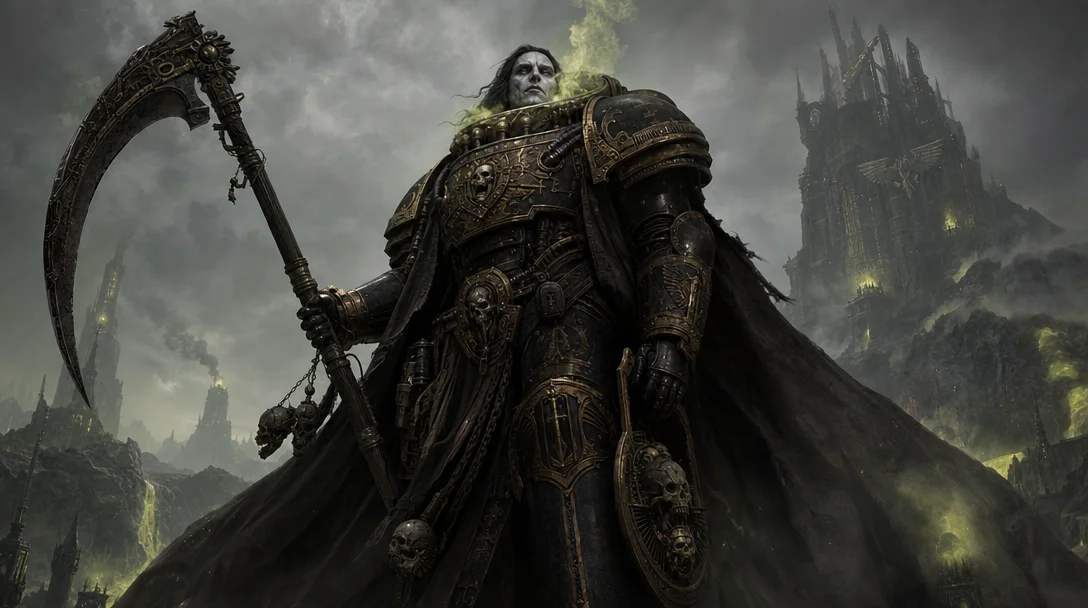
Mortarion, Part I: The Lord of Barbarus
Mortarion's origin story — from his crash-landing on the toxic world of Barbarus and his adoption by the greatest Overlord warlord, to his rebellion on behalf of the enslaved valley humans, the Overlord Wars that birthed the Death Guard, and his reluctant submission to the Emperor at the summit of his foster father's mountain fortress.
Before he became the Pale King of a plague-ridden daemon world, before he commanded a Legion of walking pestilence at the gates of Terra, Mortarion was a child screaming on a battlefield nobody else had survived. That scream would cost him everything. It would also forge him into one of the most relentless warriors the Imperium of Man ever put in the field — and one of the most bitter.
This is Part I of his three-part chronicle: the years on Barbarus, the Overlord Wars, and his first steps as Primarch of the Death Guard.
A world of poison and fog
Barbarus was not a world built for human life. 1
Orbiting close to a dim yellow sun in Segmentum Tempestus, the planet was perpetually shrouded in virulent atmospheric fog. Short, shadowy days blurred into long nights. Deadly predators prowled the toxic cloud layer, forcing the human population — remnants of ancient colonists dropped there millennia before — to huddle in the valleys and low plains, the only zones where the air was thin enough to breathe. Above them, the fog thickened as the ground rose, and up in the mountains, beyond the reach of unaugmented human lungs, lived the Overlords.
The Overlords were not human. They were a xenos species — cruel, powerful warlords who had enslaved the valley populations, raiding settlements for captives to use in torture and dark experimentation. They built vast grey fortresses in the high mountains, where the poisonous atmosphere was impenetrable to their subjects. The humans below served them out of helplessness, not choice, condemned to lives of servitude with no visible way out. Their world was defined by what was above them: things they could not reach, things that came down only to take.
Into this world, Mortarion fell.
Found on a battlefield
The circumstances of his arrival followed the pattern of the other Primarchs: the infant gestations created by the Emperor on Terra were seized by the Ruinous Powers mid-transit and scattered across the galaxy, each landing in a different corner of the human domain. 2
Mortarion came down at the site of a massive battle. Bodies stretched for miles in every direction — the dead and dying from a clash between Overlord armies. The greatest of the warlords was still there, revelling in his victory, when the silence was broken by a child's cry.
According to the Stygian Scrolls of Lackland Thorn — the historian attached to the explorator fleet that later discovered Barbarus, and the only consistent source for these events — the warlord walked that battlefield for an entire day searching for the source of the sound. When he found the infant, he considered killing it. No human child could breathe at that altitude. No human child should have been able to cry out at all. He bundled the child up and carried him away from the carnage. He had wanted a son for years, and his dark sorcerous powers had never provided one. Now something stranger than any magic had.
He named the child Mortarion — "child of death" — and raised him in the shadow of his mountain fortress.
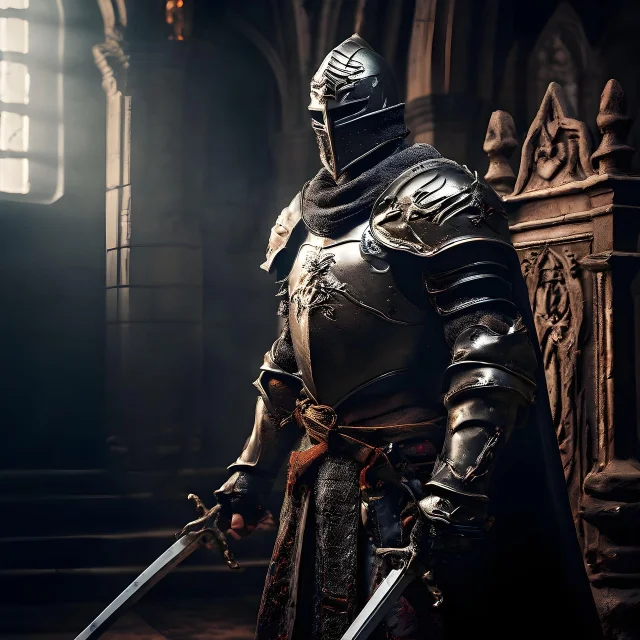
The warlord's approach to fatherhood was characteristically methodical and cruel. He tested how high the child could breathe in the poisonous atmosphere, then erected a great wall of black iron and moved his mansion just beyond it — close enough to train Mortarion in warfare, far enough to keep him contained. He taught the boy everything he knew: tactics, command, how to lead armies of undead soldiers and daemonic creatures. Mortarion fought constantly, always at the front of his foster father's campaigns against other Overlord warlords, honing skills that would eventually be turned against the very hands that shaped them.
But the warlord had miscalculated. He understood Mortarion's capabilities. He did not understand the boy's loyalties.
Descent into the valley
Witnessing the Overlords haul away human captives for torture and experimentation eventually broke something in Mortarion. He slipped away from his adoptive father's holdings and descended the mountain. The warlord's bellowing threats followed him down — to return would mean death. Mortarion descended anyway. 2
His first shelter came with a young man named Calas Typhon, who would go on to become one of the most significant figures in Mortarion's entire story. But that reckoning lay in the far future. For now, there was only the valley below, and the sensation of encountering his own people for the first time.
Mortarion noticed things he had never experienced: the smell of food being cooked, laughter that wasn't the victorious bray of a conqueror, people moving through air without a gas mask. He understood, with the directness of a young mind formed entirely by violence, that these were the people the Overlords hunted. They were his people.
His acceptance among the valley humans was not immediate. His appearance was wrong: ashen, hollow-eyed, enormous even as a youth, he was the physical image of the things that came down from the mountains to take. Most of the villagers were afraid of him. Some tried to drive him away. Mortarion waited them out, working alongside them in the fields, doing the labour nobody else wanted, proving himself useful before he was accepted. He was patient in this the way he was patient in nothing else.
The moment that changed everything came when a lesser warlord descended with a shambling force of undead troops and began carrying off villagers. This was the rhythm of life in the valleys — the raids came, and you either fled or were taken. But this time Mortarion entered the fight.
He dwarfed every man around him. He carried a massive two-handed scythe and drove into the undead ranks with a hatred years in the building, scattering the enemy and pursuing the warlord back up into the toxic zone above. The warlord, confident in the protection of altitude, had no idea what followed him. Mortarion killed him in the fog. 2
His place among the valley people was sealed.
The Overlord Wars
What followed was a campaign of systematic liberation — one warlord at a time.
Mortarion moved from settlement to settlement, teaching what he had learned in the Overlord's fortress: how to fight, how to defend, how to survive in difficult terrain. Villages became strongholds. Raw farmers became soldiers. Blacksmiths were redirected from tools to weapons and armour. His recruits — the strongest and most resilient — became the core of what he called the Death Guard, named for their willingness to walk into conditions that killed ordinary men. 2
The critical problem was the fog. Humans could repel raids from below. They could not pursue the Overlords up into the toxic atmosphere and finish the war. Every campaign stalled at the fog line. Every surviving warlord simply retreated higher and waited.
Mortarion solved this with engineering. He continually improved breathing apparatus for his troops — crude at first, progressively more effective — and drove his Death Guard higher and higher into the poisonous cloud on each campaign. The constant exposure to the toxins had an unintended side effect that would define the Legion for millennia: it hardened his warriors into men who could absorb suffering that would kill anyone else. Pain became a companion rather than a signal to retreat. Endurance became the unit's defining trait.
One by one, the Overlord fortresses fell.
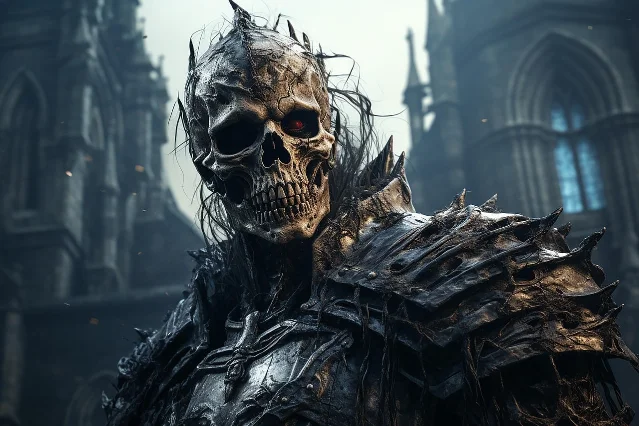
One remained: the mansion of the man who had raised him.
The Emperor's wager
Mortarion returned to his home village confident in the knowledge that the final battle was imminent — and found it had already begun, in a different way. Word had come of a remarkable visitor. A stranger. He was making promises of salvation.
Mortarion's reaction to this news was not gratitude. It was anger. 2
The final reckoning with his adoptive father had been building for his entire life. He was not going to share it with anyone. He arrived at the village meeting to find the elders seated with a stranger who was his physical inverse in every way: where the valley people were gaunt and pale from generations lived in thin air and near-starvation, this stranger had bronzed skin, perfect physique, and the bearing of something older and stranger than any warlord. The bond of recognition that hit Mortarion was immediate and visceral — he did not understand it, had no context for it, but could not deny it.
The stranger made a proposal. If Mortarion could take the last mansion alone, the final reckoning was his. If he failed, he would submit to the stranger's authority entirely. Mortarion turned without a word and began climbing.
He climbed higher than he had ever gone. The atmosphere deteriorated around him. His breathing equipment began corroding in the toxins. He kept going, driving himself upward on the accumulated hatred of decades, gasping for breath, until he could no longer move.
His adoptive father came down to finish what he had promised years before — the death of a son who had turned against him. In the final moment, the stranger stepped between them and killed the warlord with a single sweep of his sword.
When Mortarion recovered, he knelt and pledged his service. Only then did the stranger reveal himself: the Emperor of Mankind. His genetic father. The being whose genome had created him, and who had come to reclaim the son he had scattered. 2
The Emperor was the only person in the universe who had ever beaten Mortarion to a victory. The humiliation of that moment would stay with him far longer than the reunion.
"You are my unbroken blades"
The Emperor gave Mortarion command of the XIV Legion — a Space Marine force created from his own gene-seed, which had been fighting independently for over eight decades under the name the Dusk Raiders. 3
The Dusk Raiders had built their reputation as heavy infantry specialists, deploying in the role of the Emperor's relentless "red right hand" — their right arms and shoulders painted crimson as a deliberate signal of their function. They operated at twilight when shifting light disoriented sentries. They favoured endurance over speed, grinding campaigns over decisive strikes. They were, in temperament and method, already close to the Legion Mortarion would create.
When Mortarion first saw them assembled, his words became legend: "You are my unbroken blades. You are the Death Guard."
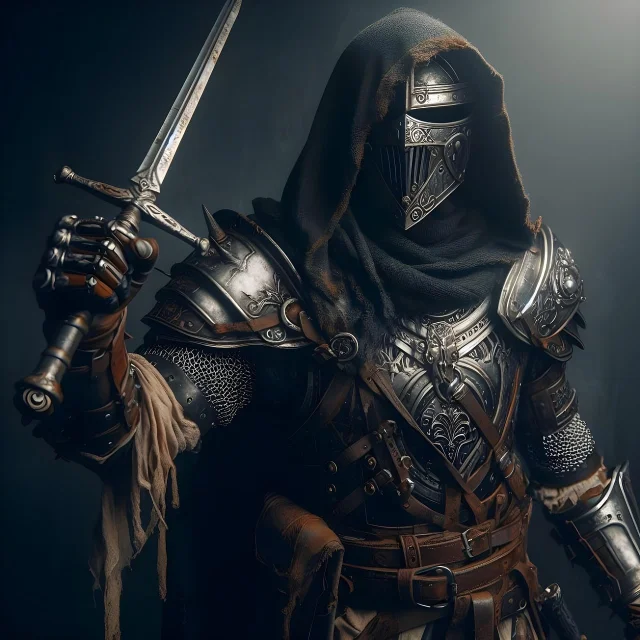
The name was engraved above the airlock of the battle-barge Reaper's Scythe. The colours shifted — the crimson trim replaced by dark green, armour remaining the pale unpainted grey that had characterised the Death Guard of Barbarus. Mortarion's veterans from the Overlord Wars formed the Legion's core. The breathing apparatus and toxin-resistance drills that had broken open the fog-defended mountain fortresses became standard practice across the entire force. The Legion did not divide into dedicated Assault and Tactical squads as other Legions did; every Death Guard marine carried a bolter, a bolt pistol, and a close-combat weapon, trained to fight with whatever the situation demanded. They were foot soldiers, built for campaigns where the environment itself was the primary enemy. 3
Among the Primarchs
Mortarion's relationships among his brother Primarchs reflected the man he had become on Barbarus: guarded, fiercely independent, deeply suspicious of anything that resembled the mystical or the sorcerous.
He found genuine camaraderie with only two brothers: Horus and the Night Haunter. He was actively avoided by Perturabo and Lion El'Jonson. His relationship with Jaghatai Khan was a running friction — Khan observed that besides himself, Mortarion was the only Primarch whose deeds were not well known to the broader Imperium, and Mortarion knew it. 2
His most visible antagonism during the Great Crusade was directed at Magnus the Red. Mortarion hated all things related to the Warp and the psychic arts — a hatred rooted directly in Barbarus, where sorcery had been the currency of oppression. The Overlords had ruled through dark magical powers. The Emperor had killed his foster father "defying the fog" in a way that could only be described as supernatural. Mortarion had spent his entire life on the receiving end of forces he could not control or understand, and his response was a deep, consistent loathing of the whole category.
He became one of the chief voices at the Council of Nikea to ban Librarians — psyker-warriors — from the Space Marine Legions. The ban passed. 2
There was also a private unease that grew during the Crusade. Mortarion sneaked into the Imperial Palace and found the Golden Throne under construction. It read to him as evidence of exactly what he feared: the Emperor using the Warp for his own ends. When Malcador explained that the device's purpose was to eventually free humanity from Warp dependency, Mortarion was partially reassured — but only partially. The suspicion had taken root.
He was also bitter about his perceived relegation. Jaghatai Khan noted that Mortarion was underappreciated, his Legion's deeds and history somehow less celebrated than those of other Primarchs. Mortarion agreed that Horus was the best choice for Warmaster, while simultaneously arguing that the position should never have been created — that naming any single Primarch as the Emperor's proxy would only produce conflict. He was right about the outcome, wrong about being able to prevent it.
What Part I leaves unresolved
By the close of this period, Mortarion's trajectory as a loyal Primarch appears stable: he has found the Emperor, taken command of his Legion, fought effectively across the Great Crusade, and proven his worth through campaigns including the war against the alien Jorgall. 2
But the fault lines are already visible. His hatred of sorcery will be turned against him by the very forces that understand it best. His bitterness at being manipulated will be weaponised by Horus, who identifies the Emperor-as-tyrant parallel with Mortarion's adoptive father and uses it to tip him toward rebellion. And Calas Typhon — the young man who gave Mortarion his first shelter on the descent from the mountain — has his own agenda, one that runs far deeper than loyalty to any Primarch.
Part II will cover the Horus Heresy: Isstvan III, the Drop Site Massacre, the pursuit of Jaghatai Khan, and the trap in the Warp that ended the Death Guard as the Imperium had known them.
Next episode: Mortarion, Part II — The Long Corruption
이 콘텐츠를 둘러싼 관점이나 맥락을 계속 보강해 보세요.