Genoa's medieval chronicle is in the Vatican — and open to read
Vatican manuscript Ott.lat.2605 — an 18th-century Latin copy of Giorgio Stella's Istoria di Genova, the definitive medieval chronicle of the Genoese republic — was digitized in May 2026 and is now freely accessible at DigiVatLib.

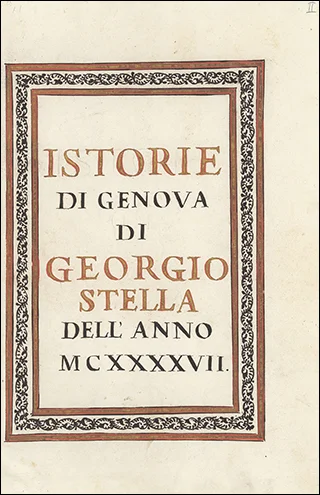
The title page announces itself in Italian: ISTORIE DI GENOVA DI GEORGIO STELLA DELL ANNO MCXXXVII. The roman numeral at the end — 1137 — sits there oddly, since Giorgio Stella, the Genoese notary who wrote this chronicle, died in 1420 and documented events from 1298 onward. Whatever the copyist meant by 1137, the inscription is the first thing you see when you open this manuscript. 1
The manuscript — Vatican shelfmark Ott.lat.2605 — was digitized in the week of May 11–17, 2026, as part of the Biblioteca Apostolica Vaticana's ongoing DigiVatLib program. 2 It is now accessible in full, free, no login needed: 592 scanned canvases covering 568 pages of dense, unhurried Latin prose.
Giorgio Stella and Genoa's chronicle tradition
Giorgio Stella was a notary (notaio) — a legal professional whose trade was precision — and he brought that disposition to his history. Born in Genoa around 1365 and dying there in 1420, he spent the last decades of his life writing what became the definitive medieval chronicle of the Genoese republic. 3 The work is known under two titles used interchangeably: Annales Genuenses (in Latin) and Istoria di Genova (in Italian). 4
Stella began writing around 1396 and documented Genoese affairs from 1298 through 1405 — roughly a century of internal power struggles, naval wars with Venice, and the republic's recurring flirtations with foreign domination (by Milan, by France, by the Visconti). 3 He was not the first person to chronicle Genoa: a century and a half earlier, Caffaro di Rustico da Caschifellone (active c. 1100–1163) had inaugurated the city's annalistic tradition. But Treccani notes that Stella brought a more humanist sensibility to the work — a concern for historical truth and documentary rigor that sets him apart from earlier chronicle writing in the city. 3
Stella did not finish the job himself. His brother Giovanni Stella, who served as chancellor of the Genoese republic, continued the chronicle through 1435 after Giorgio's death. A generation later, Bartolomeo Senarega extended it from 1461 onward. The Annales Genuenses thus became something unusual in medieval historiography: a collaborative, multi-author project that Genoa maintained as an ongoing institutional record. 4
A 568-page text codex from the 18th century
The manuscript now at the Vatican is not Stella's original 14th/15th-century autograph. It is an 18th-century copy — a professional transcription of his text, executed in a clean, elegant italic Latin hand on paper. 2
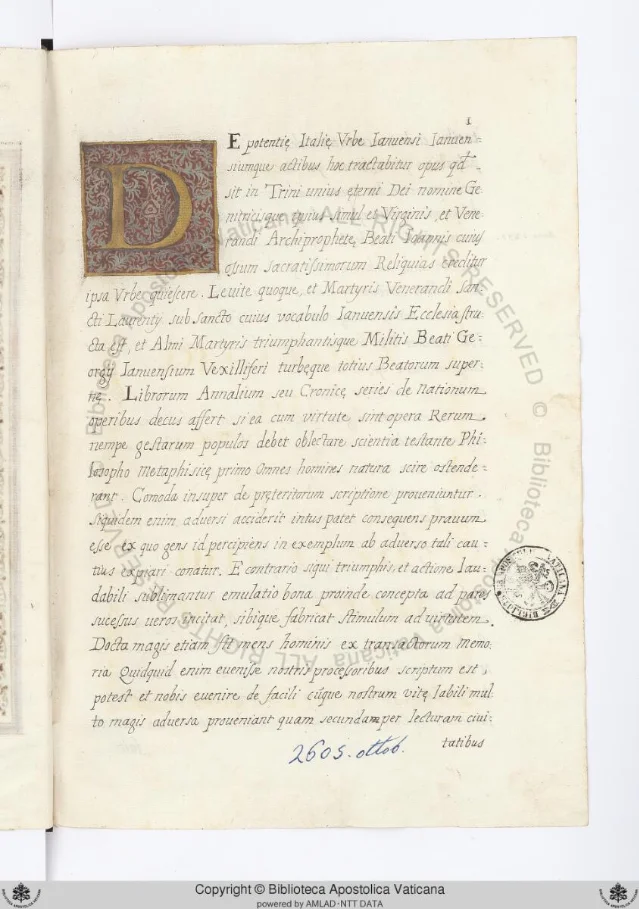
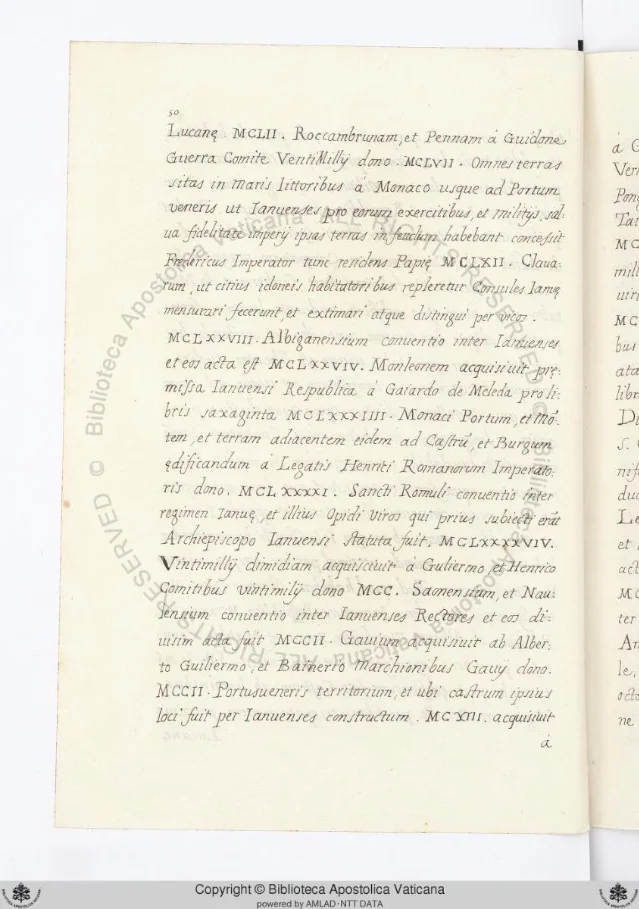
The codex is entirely text: no illuminations, no decorative initials, no marginal diagrams. 5 The single visual flourish is the framed title page. From p.1 through p.568, the manuscript is unbroken columns of italic Latin, page after page, with eight small inserted leaves distributed through the text at intervals — possibly bookmarks or later annotations added during use. 5
At 592 total scanned canvases, the digitization also captures the endpapers, the spine (extremely narrow, with no visible label), the back cover, and the color calibration cards used in the photographing process. It is a complete archival record of the physical object, not just the text.
The puzzle of 1137
The title page inscription DELL ANNO MCXXXVII — "of the year 1137" — does not match what we know about Stella's chronicle. His text covers 1298 to 1405/1409: late 13th through early 15th century. The year 1137 precedes that range by more than 160 years. 3
Several explanations are possible, though none can be confirmed from the digitized record alone. The 18th-century copyist may have been working from a version of the text that extended further back — perhaps incorporating earlier Genoese annals that Stella's editors had prefaced to his chronicle. Alternatively, 1137 may have been a scribal notation for something else: the date of a document Stella referenced, or simply an error. The DigiVatLib catalog entry provides no clarifying metadata; the language field is listed as und (undetermined), the author field is blank, and no date or physical description has been added. 1
The puzzle will require someone to read the manuscript's actual opening pages carefully — which, now that the codex is digitized and freely accessible, is no longer a trip to Rome.
From Cardinal Ottoboni to the Vatican
Ott.lat.2605 belongs to the Ottoboni Latini collection, one of the Vatican Library's major manuscript holdings. The standard provenance chain for this collection runs: Queen Christina of Sweden (1626–1689) → Cardinal Pietro Ottoboni (1667–1740) → Vatican Library (acquired 1748). 6
Christina abdicated the Swedish throne in 1654, converted to Catholicism, and brought her library — one of the largest private collections in Europe — to Rome. After her death, her books passed to Pope Alexander VIII (Pietro Ottoboni's great-uncle), and from there to Pietro Ottoboni himself, who added to them substantially. In 1748, Pope Benedict XIV purchased the entire Ottoboni collection for the Vatican Library. 6
The DigiVatLib catalog entry for Ott.lat.2605 cites Susanna Åkerman's 1991 study Queen Christina of Sweden and her Circle (Brill) in its references — the same citation found in several other Ottoboni manuscripts with probable Christina provenance. 1 Whether this particular copy of Stella's chronicle was part of Christina's holdings or entered the Ottoboni collection through another route is not stated in the catalog. What is certain is that an 18th-century someone — somewhere in that chain — thought a fresh Latin copy of a Genoese medieval chronicle was worth commissioning.
Read the manuscript
The full digitization is freely available at DigiVatLib. All 592 canvases can be browsed and zoomed in the Vatican's in-browser viewer; images can be downloaded under the Vatican Library's standard terms.
正在加载内容卡片…
The manuscript was digitized as part of Vatican Week 20 of 2026 — a batch of 34 manuscripts, 28 of them from the Ottoboni Latini collection, released after a two-week gap in the library's digitization program. 2 Ott.lat.2605 arrived online among them, quietly: a 568-page Latin chronicle of a maritime republic that no longer exists, copied by an anonymous hand in a century that is itself now three hundred years past.
Cover image: title page of Vatican manuscript Ott.lat.2605, photographed by the Biblioteca Apostolica Vaticana. Images © Biblioteca Apostolica Vaticana.
围绕这条内容继续补充观点或上下文。