1,400 years of silence: the Rosetta Stone, EA 24

1,400 years of silence: the Rosetta Stone, EA 24

A granodiorite fragment pulled from a Mamluk fort in the Egyptian delta by French soldiers in 1799, taken by British soldiers in 1801, and placed in the British Museum in 1802 — the Rosetta Stone (EA 24) carries a routine priestly decree from 196 BCE in three scripts. That bureaucratic redundancy made it the instrument through which Jean-François Champollion ended 1,400 years of hieroglyphic silence on 14 September 1822. The article traces the full arc: the Memphis Decree as political transaction under a 12-year-old Ptolemaic king in crisis, discovery by Lieutenant Bouchard at Fort Julien, the bitter argument over Article 16 of the Capitulation of Alexandria, the decipherment race from de Sacy and Åkerblad through Thomas Young to Champollion's faint and the Lettre à M. Dacier, the Young–Champollion priority dispute, and the ongoing Egyptian repatriation demands since 2003.
Museum Artifact Story Pick
2026/5/28 · 23:25
2 订阅 · 3 内容
There is a slab of rock in Room 4 of the British Museum — dark grey, glittering with crystals, about the size of a large cutting board set upright — and for more than two centuries it has been the single most-visited object in the building. Most of the people who stop in front of it know, roughly, what it is: something to do with ancient Egypt, something to do with writing. The full story is considerably stranger.
The stone is broken. The top third is gone, snapped away sometime between the reign of the Roman emperor Theodosius I and the middle of the fourteenth century, and nobody knows exactly when or how. 1 What survived is a fragment — 112.3 centimeters tall at its highest point, 75.7 centimeters wide, 28.4 centimeters thick, weighing approximately 760 kilograms — and it carries, in three different scripts, a bureaucratic decree from a kingdom that was already running out of time. 1
That fragment spent at least three centuries buried in the foundations of a military fort in the Egyptian delta. It was pulled out by French soldiers in 1799. It was taken by British soldiers in 1801. It has been on public display in London almost without interruption ever since. And it was the instrument through which, in 1822, a 31-year-old Frenchman named Jean-François Champollion put his pen to paper and ended fourteen hundred years of silence.
What follows is the story of how a piece of broken stone became the most consequential fragment in the history of writing.

A kingdom in trouble and the priests who ran it

To understand what the Rosetta Stone is, you have to understand what it was supposed to be.
In 196 BCE, Egypt was nominally ruled by Ptolemy V Epiphanes — "the manifest god," as his title translated — who was twelve years old. 2 He had become king at five, after his father Ptolemy IV and his mother Arsinoe III were murdered in a palace conspiracy involving the king's mistress Agathoclea. His early reign was a period of cascading crisis: a rebel native pharaoh named Horwennefer controlled Upper Egypt, a separate insurgency threatened the delta, and outside Egypt's borders the Seleucid emperor Antiochus III and the Macedonian king Philip V had reached an agreement to carve up the Ptolemaic empire's overseas territories. 3 The Battle of Panium in 198 BCE had just cost Egypt the province of Coele-Syria — which included Judea — permanently. 1
Ptolemy had only been formally crowned in Memphis in 197 BCE, nine years after inheriting the throne. His coronation was late by any standard: Foy Scalf of the American Research Center in Egypt (ARCE) has described the scene as "a child king manipulated by regents in a moment of dynastic desperation," whose real power lay with the priestly class managing the temples. 3 One year after the coronation, on 27 March 196 BCE, a council of priests gathered in Memphis and issued what scholars now call the Memphis Decree.
The decree is, in essence, a contract. On one side: the king agrees to reduce taxes on the army and the general population, restore temple revenues and endowments, raise priestly salaries, release prisoners, forbid the forced conscription of sailors, and fund the sacred burial rites of the Apis and Mnevis bulls. 2 On the other side: all Egyptian temples shall install a gilded statue of the king in their innermost sanctum, served by priests three times daily; the king's birthday (the 30th of every month) and his coronation anniversary (the 17th) shall be celebrated monthly across Egypt; and every priest in the country shall add to their title the honorific "Priest of the God Who Appeared, Whose Goodness Is Perfect." 2
The decree's own text describes the arrangement's reciprocal logic without any visible embarrassment:
"Of the dues and taxes existing in Egypt some he has cut and others he has abolished completely in order to cause the army and all other people to be happy in his time as Pharaoh." 2
The decree also mentions that Ptolemy has crushed a revolt at Lycopolis in the delta, executing its leaders "on stakes" at Memphis after besieging the city. 1 The benevolent framing and the impaled rebels occupy the same document.
The decree's final instruction is the one that matters for history: it orders that the text be inscribed on a "stela of hard stone" in three scripts — "the language of the gods" (hieroglyphics), "the language of documents" (Demotic), and "the language of the Greeks" (Ancient Greek, the administrative language of the Ptolemaic court) — and placed in every major temple in Egypt. 2 At least ten copies were made. Most were lost or destroyed over the following two thousand years. The Rosetta Stone, found in a delta fort, is the earliest surviving copy and the most complete. 1
The stone almost certainly stood first in a temple at Sais, the royal city of the Nile delta's interior. 1 In 392 CE, the emperor Theodosius I ordered all non-Christian temples closed. The Sais temple was presumably abandoned; the stele broke at some point, and its largest fragment was repurposed as building material, eventually incorporated into the foundations of a fortification built by the Mamluk sultan Qaitbay (c. 1416–1496) at the town of Rashid — known to Europeans as Rosetta — on the western branch of the Nile delta. 1 There it lay for at least three centuries, face-down or sideways in the rubble, utterly unknown to the scholars of Europe.

Fort Julien, July 1799

On 1 July 1798, Napoleon Bonaparte led a French expeditionary force ashore at Alexandria, beginning what he envisaged as a campaign to make France the dominant power in the eastern Mediterranean and cut Britain's route to India. 4 Napoleon understood the propaganda value of knowledge, and he brought with him something no purely military expedition had ever carried: a Commission des Sciences et des Arts (Commission of Sciences and Arts), composed of 151 scholars, artists, engineers, and scientists — his savants — whose job was to document, measure, and understand everything they encountered in Egypt. 1
The military campaign went badly almost immediately. Admiral Nelson destroyed the French fleet at the Battle of the Nile on 1 August 1798, stranding Napoleon's army in Egypt. 4 The scholarly work, however, continued. Napoleon had established an Institut d'Égypte in Cairo, modeled on the French national academy, where the savants could share their findings.
In July 1799, French engineers under Colonel d'Hautpoul were reinforcing Fort Julien, a crumbling Mamluk fortification a few kilometers northeast of Rosetta on the west bank of the Nile's Bolbitine branch. 4 The soldiers were demolishing an old interior wall to reuse the stone. Inside the rubble, a lieutenant named Pierre-François Bouchard noticed something: a dense, dark slab covered in carved inscriptions of three different kinds. 1
Bouchard and d'Hautpoul immediately recognized that it was significant and notified General Jacques-François Menou, who commanded the garrison at Rosetta. On 19 July 1799, a member of the savants commission named Michel Ange Lancret reported the find to the Institut d'Égypte and correctly identified what he was looking at: three different scripts recording the same text. 1
The commission's scholars moved quickly. Jean-Joseph Marcel confirmed that the middle text was Demotic script — previously misidentified by others as Syriac. Nicolas-Jacques Conté, the engineer who had invented the modern graphite pencil, devised a method of using the stone itself as a printing plate, taking inked impressions of its surface. Charles Dugua, a French general, carried these casts back to Paris when he was dispatched to France in September 1799, so European scholars could examine the inscriptions before the stone itself arrived. 1
The Courrier de l'Égypte — the French army's official newspaper in Egypt — published a report on the discovery in its 37th issue. An anonymous writer noted: "This stone is of great interest for the study of hieroglyphic characters; maybe it will even prove to be the key to understanding them." 4
That was September 1799. Champollion would not be born until December of the previous year — he was nine months old.

The trophy and the argument

Napoleon left Egypt in August 1799, sailing quietly back to France to stage the coup that would make him First Consul. He left his army behind. In 1801, a joint British-Ottoman force landed at Abu Qir Bay, and the French military position in Egypt collapsed over the following months. 4 General Menou — who had converted to Islam and married an Egyptian woman, renaming himself Abdullah Menou — commanded the French forces in their final stand at Alexandria.
On 30 August 1801, Menou signed the Capitulation of Alexandria. Article 16 of the surrender agreement specified that all objects collected by the French commission during the occupation would become the property of the victorious powers. 4
What followed was an argument whose bitterness exceeded anything the military campaign had produced. Menou declared that the antiquities were private property belonging to the scholars of the Institut d'Égypte, not war spoils. The French naturalist Étienne Geoffroy Saint-Hilaire threatened that the scientists would rather burn their collections than hand them over — invoking, deliberately, the memory of the burning of the Library of Alexandria. 1 The British commander, General John Hely-Hutchinson, replied that he would not lift the siege of Alexandria until every object was surrendered.
Menou, when he could no longer hold out, declared that the Rosetta Stone specifically was his private property. 4 How it was actually removed from his possession became the subject of two contradictory accounts. Colonel Tomkyns Hilgrove Turner later told the Society of Antiquaries of London that he personally had taken it away on a gun carriage. A scholar named Edward Daniel Clarke described a different scene: a French member of the Institut had led Clarke through back alleys to where the stone was hidden under carpets in Menou's baggage, warning that French soldiers might steal it before the British could claim it. 1 Both accounts cannot be fully true. The stone arrived in British hands regardless.
Turner placed the stone on the captured French frigate HMS L'Égyptienne and sailed for Portsmouth, arriving in February 1802. 5 On 11 March 1802, before it went to the museum, Turner displayed it to the Society of Antiquaries. Four plaster casts were made and sent to Oxford, Cambridge, Edinburgh, and Trinity College Dublin, so scholars at each institution could begin work on the inscriptions. 1
In a letter to the Society of Antiquaries, Turner described the stone as "a proud trophy of the arms of Britain (I could almost say spolia opima), not plundered from defenceless inhabitants, but honourably acquired by the fortune of war." 4 The phrase spolia opima — the highest honor a Roman general could claim, granted only to one who killed an enemy commander in single combat — gives a sense of how Turner understood what had happened. He also predicted the stone would remain in London as "a most valuable relic of antiquity, the feeble but only yet discovered link of the Egyptian to the known languages." 4
He was right about the second part.
The stone went to the British Museum in June 1802, by direction of King George III, and has been on public display there — in the Sculpture Gallery, later Room 4 — almost continuously since. 1 The only interruptions: during World War I, when it was moved 15 meters underground into a postal railway tunnel near Holborn to protect it from German bombardment (1917–1919); and once in October 1972, for a single month, when it traveled to the Louvre for an anniversary exhibition. 1
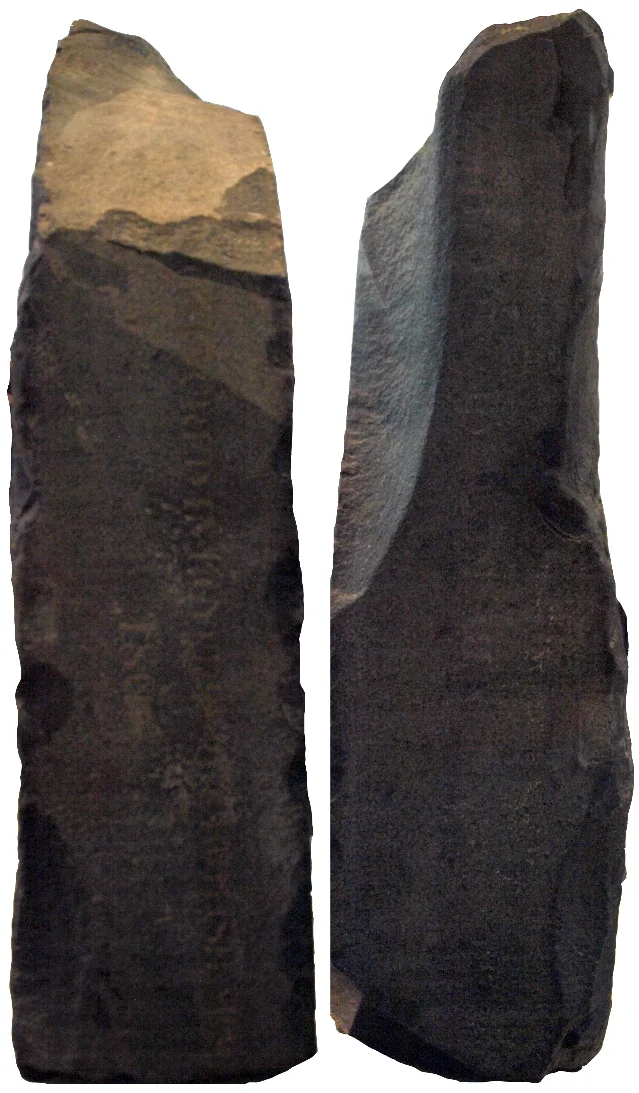
The stone's sides carry white-painted English inscriptions added after its arrival in London. On the left: "CAPTURED IN EGYPT BY THE BRITISH ARMY IN 1801." On the right: "PRESENTED BY KING GEORGE III." 1
The sides of the Rosetta Stone bearing white English inscriptions added after its arrival in London in 1802
The stone's left and right flanks carry painted inscriptions recording the British Army's capture of the stone in 1801 and its donation by George III. Both were added after the stone arrived in London. 1

What the stone actually says

Before Champollion, and before the decipherment race, the stone needed to be understood on its own physical terms.
The original stele — before it broke — was significantly larger. Based on comparison with the Canopus Decree stele (238 BCE, still largely intact at 219 cm tall), scholars estimate the missing top section contained 14 to 15 additional lines of hieroglyphic text and a carved lunette above: a winged sun disk, and below it a scene depicting the king before assembled gods. 1 The complete original would have stood approximately 149 centimeters high. What we have is about two-thirds of it.
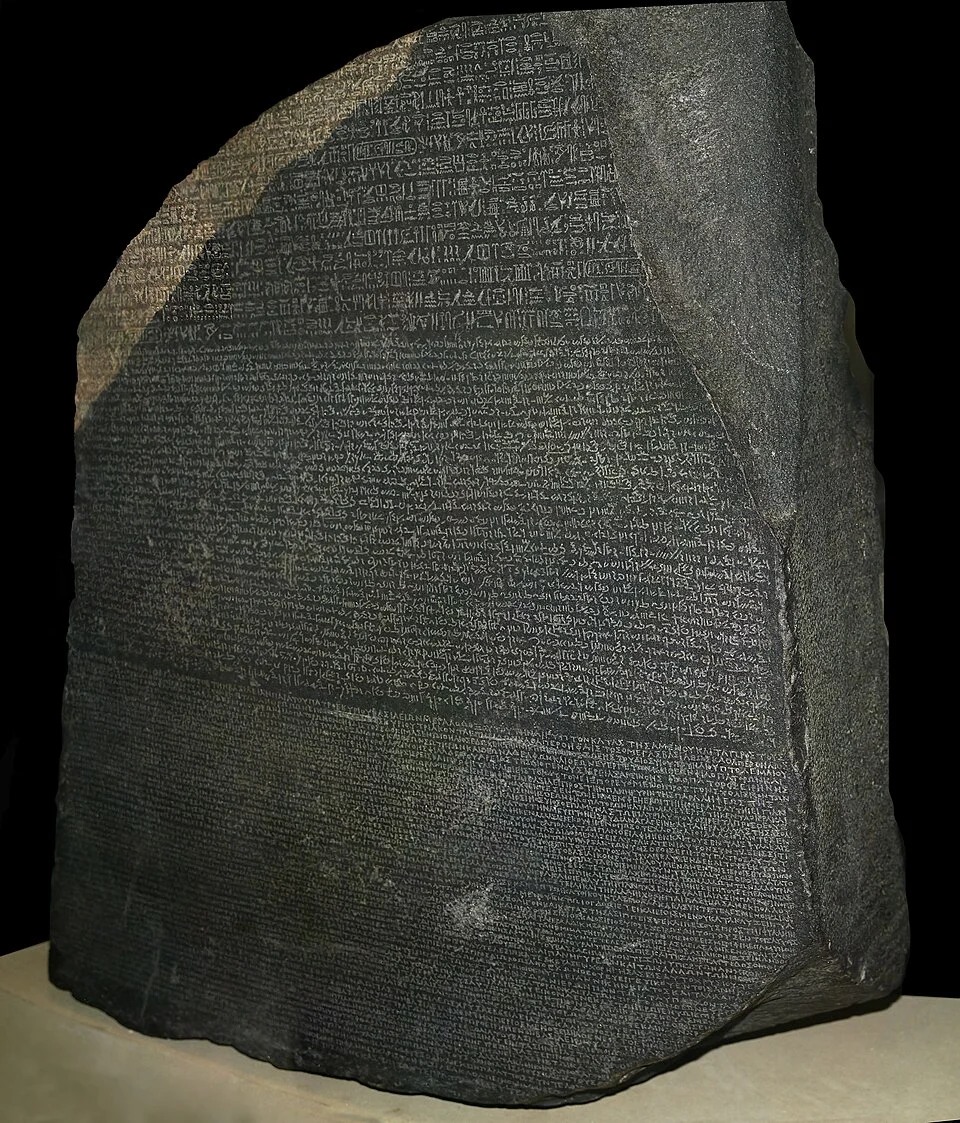
The three texts are not in equal condition. The hieroglyphic section at the top is the most damaged: only 14 lines survive, all broken on the right side, and 12 of those 14 are also broken on the left. The Demotic section in the middle is the best-preserved, with 32 lines; the first 14 have some damage on the right, the rest are essentially intact. The Greek section at the bottom has 54 lines; the first 27 are complete, the remainder damaged by the oblique fracture at the lower right corner. 1
The stone is not black, despite what most people assume and what the earliest French report described as "a beautiful black granite stone, of fine grain and hard as a hammer." 4 It is granodiorite — a crystalline igneous rock similar to granite but richer in certain feldspars — and it is dark grey, not black. For most of its time in the British Museum, the stone's surface was coated with white chalk (to make the inscriptions readable in photographs) and carnauba wax (to prevent visitors from touching it). These coatings made it look darker and more uniform than it is. In 1999, the museum cleaned the stone in public — the work was performed on the gallery floor so visitors could watch — and what emerged was the rock's actual character: deep grey with a glinting crystalline texture, and a pink vein of feldspar running across the upper left corner. 1 Geochemical analysis traced the stone's origin to a small quarry called Gebel Tingar, on the west bank of the Nile near Elephantine at Aswan. 1
Since 2004, the cleaned stone has stood in a dedicated glass case at the center of the Egyptian Sculpture Gallery. In the King's Library (now the Enlightenment Gallery), the museum keeps a touchable replica. 1

The race to read it

The Greek text presented no particular difficulty. Stephen Weston delivered an oral English translation to the Society of Antiquaries in April 1802. More polished translations in Latin and French followed from Hubert-Pascal Ameilhon in Paris (1803) and Christian Gottlob Heyne at Göttingen (also 1803). 1 The decree's contents became known to European scholars quickly.
The Greek text confirmed that the other two scripts contained the same information. This meant that if a scholar could match Greek words to Demotic or hieroglyphic equivalents — particularly proper names, which would be spelled phonetically in any script — the scripts might be cracked.
In 1802, the French orientalist Antoine-Isaac Silvestre de Sacy received a lithographic print of the stone from the French Minister of the Interior, Jean-Antoine Chaptal. De Sacy identified five Greek royal names — Alexandros, Alexandreia, Ptolemaios, Arsinoe, and the title Epiphanes — in the Demotic text. 6 The Swedish diplomat Johan David Åkerblad took de Sacy's results further and published a 29-letter alphabet of Demotic phonetic characters, more than half of which turned out to be correct. 6 Both men eventually stalled: neither could make sense of the ideographic characters mixed into the phonetic ones, and the hieroglyphic text remained a total mystery.
Progress came in 1811, when de Sacy wrote to the English polymath Thomas Young (1773–1829) — Foreign Secretary of the Royal Society, the man who had already formulated the wave theory of light and described the mechanism of the human lens — suggesting that the cartouches (the oval rings surrounding certain hieroglyphic groups) enclosed royal names written phonetically. 6 Young began working seriously on the stone in 1814.
By 1819, Young had identified the cartouche of Ptolemy V and correctly proposed phonetic values for five of its signs: p, t, o, l, m, and s. 7 He established the reading direction of hieroglyphs (characters face the direction you read from), discovered approximately 80 correspondences between hieroglyphic and Demotic signs, and recognized that Demotic was a hybrid of phonetic and ideographic elements. 6 He published his findings in an article titled "Egypt" in the 1819 Encyclopædia Britannica — giving conjectural translations for 218 Demotic words and 200 hieroglyphic ones. 7
Young had found a door. He could not figure out how to open it. His crucial limitation was a belief — reasonable at the time but ultimately wrong — that phonetic hieroglyphic signs were used only for foreign names like Ptolemy and Cleopatra, not for native Egyptian words. This meant his system had an inbuilt ceiling: the moment he tried to read a hieroglyphic text that did not involve a Greek or Roman name, it stopped working.
The Egyptologist Richard Parkinson has summarized the situation precisely: "Young discovered parts of an alphabet — a key — but Champollion unlocked an entire language." 6
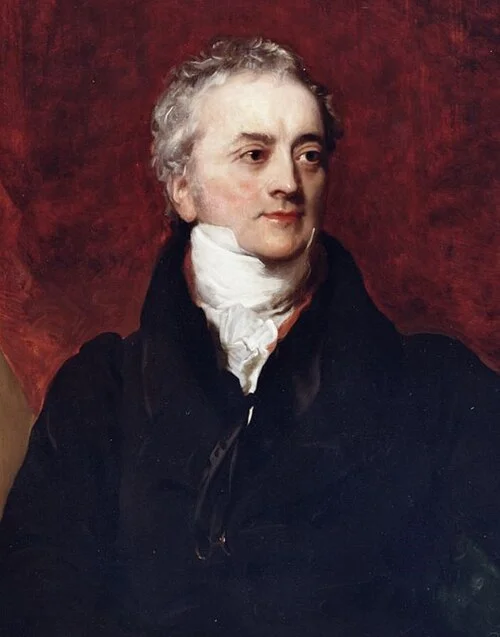
Portrait of Thomas Young by Henry Perronet Briggs, 1822 — the same year Champollion announced his breakthrough
Thomas Young (1773–1829), portrait by Henry Perronet Briggs, 1822. Young identified several phonetic values in the Ptolemy cartouche and proved the relationship between hieroglyphic and Demotic script — but never accepted that phonetic hieroglyphs applied to native Egyptian words. 7

September 14, 1822

Jean-François Champollion was born in Figeac in the Lot on 23 December 1790. He was, by any measure, a prodigy with a singular obsession: Egypt. In 1806, at the age of fifteen, he wrote to his brother Jacques-Joseph: "I want to make a profound and continuous study of this antique nation. The enthusiasm that brought me the study of their monuments, their power and knowledge filling me with admiration, all of this will grow further as I will acquire new notions. Of all the people that I prefer, I shall say that none is as important to my heart as the Egyptians." 8
He taught himself Coptic — the latest form of the ancient Egyptian language, written in a Greek-derived alphabet and still used liturgically in Egyptian Christian churches — so that he would know what Egyptian sounded like when he finally read it. This turned out to be the decisive advantage.
By 1822, Champollion had been working on hieroglyphs for years, and he had reached the same point as Young: the phonetic system seemed to apply only to foreign royal names. The breakthrough came not from the Rosetta Stone but from an obelisk at Philae, which bore two cartouches in both Greek and hieroglyphic — one for Ptolemaios, one for Kleopatra. 6 By aligning the two cartouches, Champollion could assign values to hieroglyphic signs that appeared in one name but not the other. He extended his alphabet to nine letters.
Still, nothing he could yet read was in native Egyptian. That changed on 14 September 1822, when Champollion was examining drawings sent from Abu Simbel in Nubia by the architect Jean-Nicolas Huyot. The drawings showed cartouches from temple inscriptions — far older than anything Ptolemaic. One cartouche appeared to contain a sun disk (the hieroglyph for re, the sun god), followed by two signs that Champollion already knew from his Ptolemaic work, followed by one more. Sun disk (re), plus unknown sign (m in his emerging alphabet), plus s, plus s. Re-m-s-s.
Ramesses.
The king who had ruled Egypt 1,200 years before the Ptolemies. A native Egyptian pharaoh. His name was spelled phonetically — in hieroglyphs. Champollion recognized, all at once, that the phonetic system was not limited to foreign names. It was the core of the script itself. Hieroglyphic writing was phonetic, symbolic, and pictorial simultaneously — "a complex system," he later wrote, "a script all at once figurative, symbolic and phonetic, in one and the same text, in one and the same sentence, and, I might even venture, one and the same word." 6
His biographer Hermine Hartleben recorded what happened next: Champollion ran to his brother's office at the Académie des Inscriptions, cried "Je tiens mon affaire!" — I've got it! — and collapsed in a faint that lasted nearly a week. 8
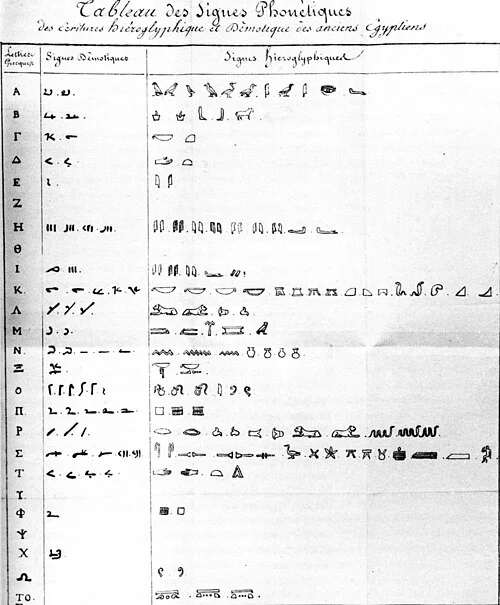
On 27 September 1822 — thirteen days after the breakthrough — Champollion read his Lettre à M. Dacier to the Académie royale des Inscriptions et Belles-Lettres. The letter announced a complete phonetic alphabet for hieroglyphs. Thomas Young was in the audience. 6
The letter is now regarded as the founding document of Egyptology — the moment when the discipline began.
Champollion's table of hieroglyphic phonetic characters and their Demotic and Greek equivalents, published in the Lettre à M. Dacier, 1822
Champollion's phonetic alphabet table from the Lettre à M. Dacier (1822). Each row pairs a Greek letter, its Demotic equivalent, and its hieroglyphic sign. This is the document that ended 1,400 years of silence. 6

What Young said afterward, and what it means
The relationship between Young and Champollion then deteriorated publicly and with considerable heat. The Lettre à M. Dacier mentioned Young only twice — once for his Demotic work and once critically for misreading the name "Berenice." 8 Young felt his contributions had been written out of the story. In 1823, his English supporters published a series of articles in the Edinburgh Review accusing Champollion of plagiarism. Champollion's response was direct: "I shall never consent to recognise any other original alphabet than my own." 8
Young, writing privately after the September reading, found a more sardonic register: "if [Champollion] did borrow an English key, the lock was so dreadfully rusty, that no common arm would have strength enough to turn it." 8
The dispute had genuine nationalistic undercurrents — British scholars tended to champion Young; French scholars, Champollion. In 1828, the year before Young died, Champollion supported Young's election to the French Académie des Sciences, a gesture that hinted at some form of late reconciliation. 8
Modern scholarship has largely settled the question. Young made the first decisive breach: cartouches, partial phonetic values, the relationship between the two scripts. Champollion did everything else: a complete phonetic alphabet, proof that the system applied to native Egyptian, the grammar, and the dictionary. Dr. Okasha El Daly of UCL has placed this in broader context: "Scientific progress is an accumulated thing. Champollion did not work from nothing. He started from studying earlier contributions." 9 Those contributions included not only Young but also the ninth-century Iraqi scholar Abu Bakr Ahmad ibn Wahshiyya, who had attempted hieroglyph decipherment centuries before any European — and whose approach of using known scripts to read unknown ones is structurally identical to what Champollion did. 9
Champollion published the full system in his Précis du système hiéroglyphique (1824), dedicated to Louis XVIII, then traveled to Egypt in 1828–1829 to read inscriptions in the field. From Wadi Halfa in Nubia he wrote to his old correspondent Dacier: "I am proud now, having followed the course of the Nile from its mouth to the second cataract, to have the right to announce to you that there is nothing to modify in our 'Letter on the Alphabet of the Hieroglyphs.' Our Alphabet is good." 8
He died of a stroke on 4 March 1832, aged 41. His Grammaire égyptienne and Dictionnaire égyptien were published posthumously by his brother. 8
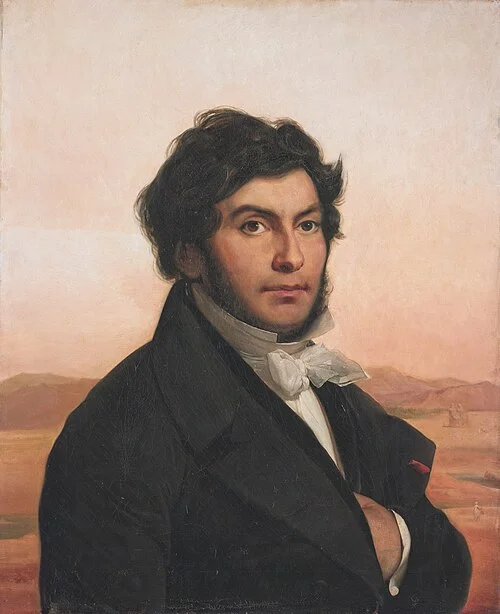
Portrait of Jean-François Champollion by Léon Cogniet, 1831, one year before Champollion's death
Jean-François Champollion, portrait by Léon Cogniet (1831). Champollion announced his breakthrough in September 1822 and spent the following decade refining and extending the system before dying at 41. 8

Where it stands now

In July 2003, Zahi Hawass (then Secretary-General of Egypt's Supreme Council of Antiquities) made the first formal public demand for the stone's return, calling it "the icon of our Egyptian identity." 1 In 2005, the British Museum donated a full-sized fiberglass replica to the Rashid National Museum in Rosetta — where the stone was found — while declining to discuss permanent return. 1 In December 2009, Hawass offered a compromise: he would drop the claim for permanent repatriation if the British Museum would loan the stone for three months for the opening of the Grand Egyptian Museum. The British Museum did not agree. 1 In August 2022, Hawass renewed the demand with an online petition that attracted thousands of signatures. 1
The British Museum's position rests on the argument that the 1970 UNESCO Convention on the Means of Prohibiting and Preventing the Illicit Import, Export and Transfer of Ownership of Cultural Property does not apply retroactively to objects acquired before that date — and also on a broader claim that objects of this significance serve humanity better in a universal museum accessible to visitors from every country. The stone's two side inscriptions do not leave much ambiguity about how the British military framed its acquisition in 1801.
The Egyptologist John Ray has noted, with some precision: "The day may come when the stone has spent longer in the British Museum than it ever did in Rosetta." 1
The stone has been on display in London for 223 years. It was buried in the rubble of Fort Julien for perhaps three centuries before that. Before that, it stood in a temple for an unknown period. Before the temple, it lay in a quarry at Aswan as undifferentiated rock.
Its name has entered nearly every language as a metaphor for any key that unlocks a previously incomprehensible field: from hydrogen's atomic spectrum ("the Rosetta Stone of modern physics," as the Nobel laureate Theodor W. Hänsch wrote in Scientific American in 1979) 1 to the European Space Agency's comet-chasing probe, launched in 2004, which researchers hoped would decode the solar system's origins. The Encyclopædia Britannica made the first figurative use in 1902, in an article about glucose chemistry. 1
None of that metaphorical weight was planned. The priests at Memphis in 196 BCE were issuing a routine administrative text — a political transaction between a frightened young king and the religious establishment that sustained his rule. They ordered copies made in three languages so that everyone in their multilingual kingdom could read the same message. They were being practical. The redundancy they built in as a bureaucratic convenience became, two thousand years later, the structure that let a fainting scholar in Paris reconstruct an entire civilization's voice.

Cover image: Rosetta Stone (EA 24) on display at the British Museum. Image: Wikimedia Commons (CC BY-SA).

围绕这条内容继续补充观点或上下文。

  • 登录后可发表评论。